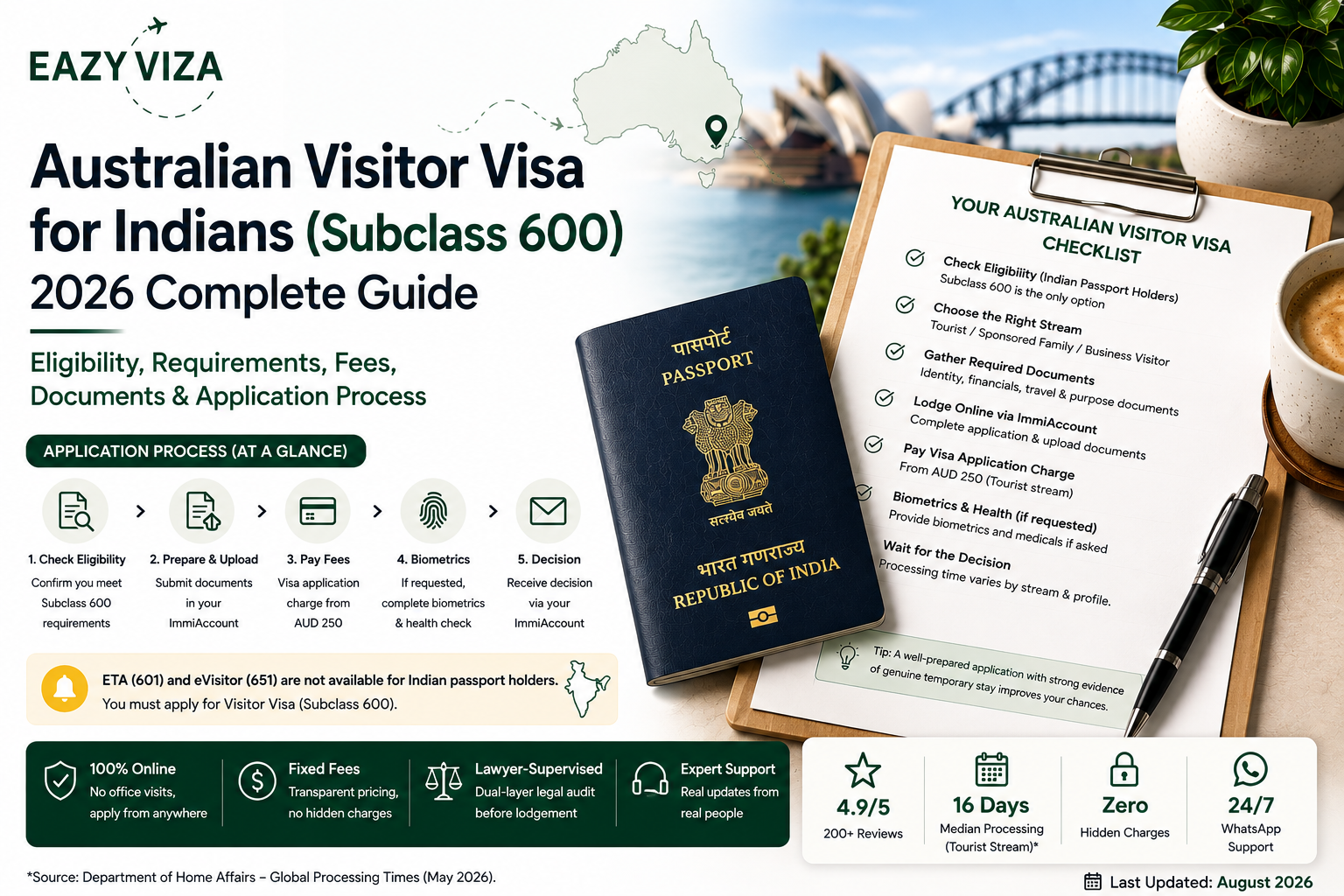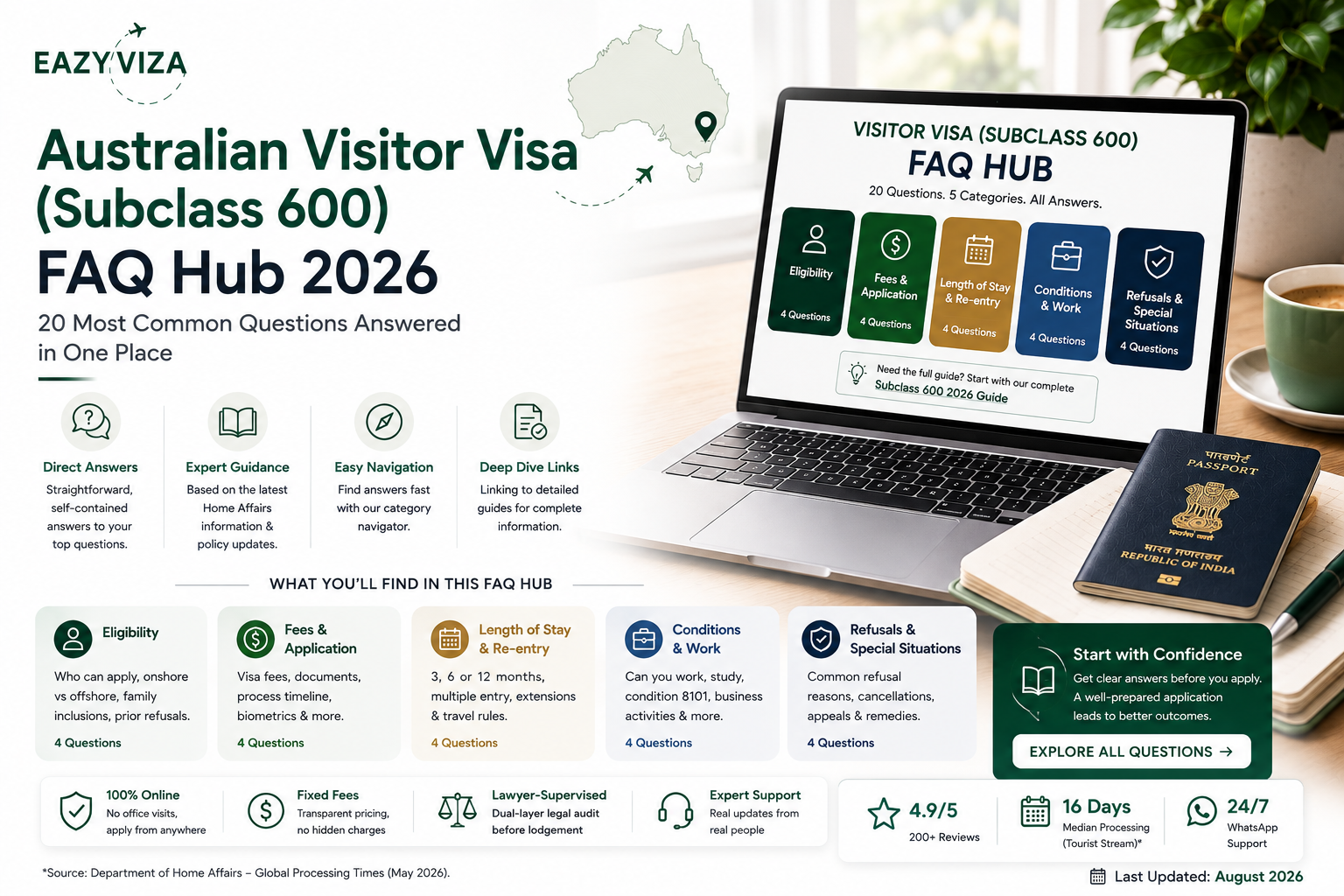
This is the question hub for the Australian Visitor Visa (Subclass 600) cluster. Every question below receives a direct, self-contained answer. Where a spoke in the cluster covers the topic in full depth, the answer links there rather than repeating content that already exists. Use the category navigator below to find your question quickly, or read through from the start if you are preparing an application and want a full picture before you begin.
What this hub covers: 20 of the most commonly asked questions about the Subclass 600 visitor visa, organised into five categories: eligibility, fees and application, length of stay and re-entry, conditions and work rules, and refusals and special situations. For the complete application guide, see our Subclass 600 2026 guide.
Category 1: Eligibility and Who Can Apply
Q1: Who can apply for the Subclass 600 Tourist visa?
Any person of any nationality can apply for the Subclass 600 Tourist stream, from outside or inside Australia. There are no passport-based eligibility restrictions, which is what sets the Subclass 600 apart from the eVisitor (651) and ETA (601), which are limited to holders of specific European or other designated passports. For the full stream comparison and eligibility rules, see our Subclass 600 2026 guide.
Q2: Can I apply for a visitor visa while I am already in Australia?
Yes. The Tourist stream (onshore) is a separate sub-stream for applicants already in Australia on a current, lawful visa. You apply through ImmiAccount from within Australia. Document requirements are the same as the offshore Tourist stream. Before lodging, check your current visa grant notice: if condition 8503 (No Further Stay) appears, you generally cannot apply for another visa onshore. See Question 15 below for the 8503 detail.
Q3: Can I bring my spouse and children on my visitor visa?
No visitor visa covers dependants. Each family member, including children, needs their own separate Subclass 600 application. Every applicant must independently satisfy clause 600.211 of the Migration Regulations 1994, the genuine visitor intent requirement. Your financial evidence for your own file can reference the family travel, but each family member's grant, conditions, and length of stay are assessed and issued individually through their own ImmiAccount application.
Q4: Can I apply for a visitor visa if I have a previous visa refusal on record?
Yes, but the refusal must be declared in your new ImmiAccount application. Failure to declare a previous refusal from any country can constitute misleading conduct under Public Interest Criterion (PIC) 4020 and is itself grounds for a new refusal. A re-application must specifically address the reasons stated in the original decision notice. For the common refusal patterns affecting Indian applicants and how to prepare a stronger file, see our Australia visitor visa from India guide.
Category 2: Fees, Application, and After You Lodge
Need expert guidance?
Speak with a migration specialist
Get personalised advice on your visa pathway — response within 2 hours.
Q5: How much does the Subclass 600 Tourist visa cost in 2026?
The base application charge for the offshore Tourist stream is AUD 250 from 1 July 2026, paid through ImmiAccount and non-refundable even if refused. Sponsored Family and Business Visitor streams start at the same base rate. The Frequent Traveller stream costs AUD 1,845. Confirm the current amount using the Home Affairs Visa Pricing Estimator before paying, as charges are reviewed periodically.
Q6: How long does it take to get a visitor visa decision?
The current global benchmarks show a median of around 16 days for the offshore Tourist stream, with 90% of applications decided within 33 days. The Sponsored Family stream takes longer: median 38 days, 90th percentile 79 days. Applications that are complete and consistent at lodgement process faster because the case officer does not need to issue a Request for Further Information. Check the live Home Affairs processing times tool before planning travel, as these figures shift monthly.
Q7: How do I check my visa conditions after it is granted?
Use the Visa Entitlement Verification Online (VEVO) tool at immi.homeaffairs.gov.au. VEVO shows your visa subclass, grant date, arrival deadline, length of stay, and every condition attached to your current visa. You need your passport number and visa grant number from your grant notice to log in. Airlines, employers, and Border Force use the same tool to verify your visa status at any point during your stay.
Q8: What is the difference between my grant date, the "must not arrive after" date, and my length of stay?
Three separate fields on every grant notice. The grant date is when the decision was made. The "must not arrive after" date is the last day you can enter Australia on that visa. The length of stay is how long you may remain after each entry, commonly 3 months. You can arrive right up to the arrival deadline and still stay for the full permitted length of stay. For a worked example of how to read a grant notice, see our 3, 6, and 12-month duration guide.
Category 3: Length of Stay and Re-entry
Q9: Can I stay longer than 3 months on a visitor visa?
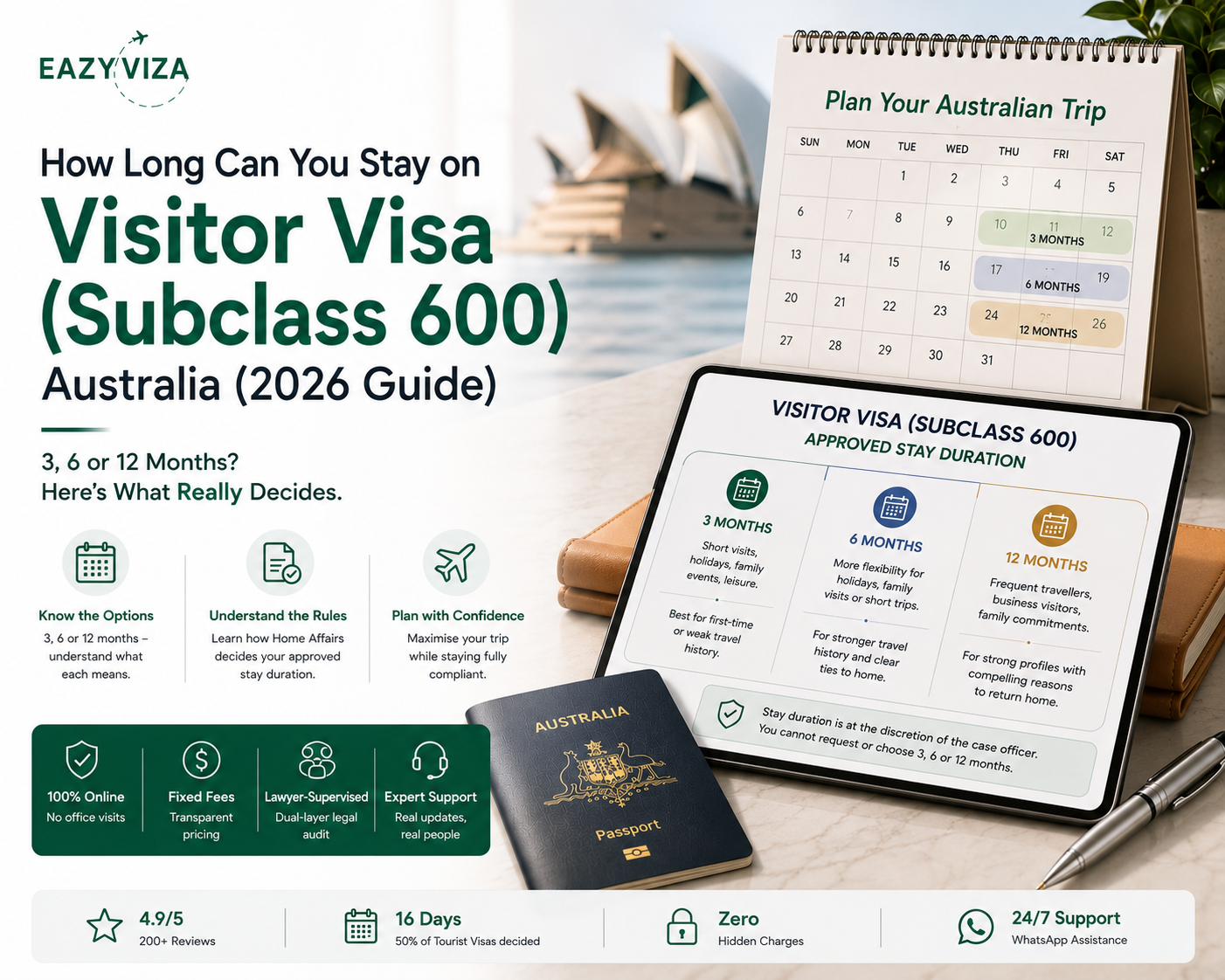
A 3-month length of stay per visit is the default for most first-time applicants, but grants of 6 or 12 months are possible depending on your circumstances and what your documents support. The case officer decides at grant: there is no field in ImmiAccount where you select a preferred duration. For how 6 and 12-month grants work, what your file must show, and the asking-for-more trap, see our duration guide.
Q10: Can I extend my visitor visa while I am in Australia?
The length of stay on a granted Subclass 600 visa cannot be extended. If you need more time, you must either depart before your permitted stay expires or lodge a new substantive visa application from within Australia, provided condition 8503 is not on your current grant. If 8503 is present, you generally must depart and apply from outside Australia. For the multiple-entry and return options, see our multiple-entry guide.
Q11: What is condition 8558 and does leaving Australia reset the 18-month clock?
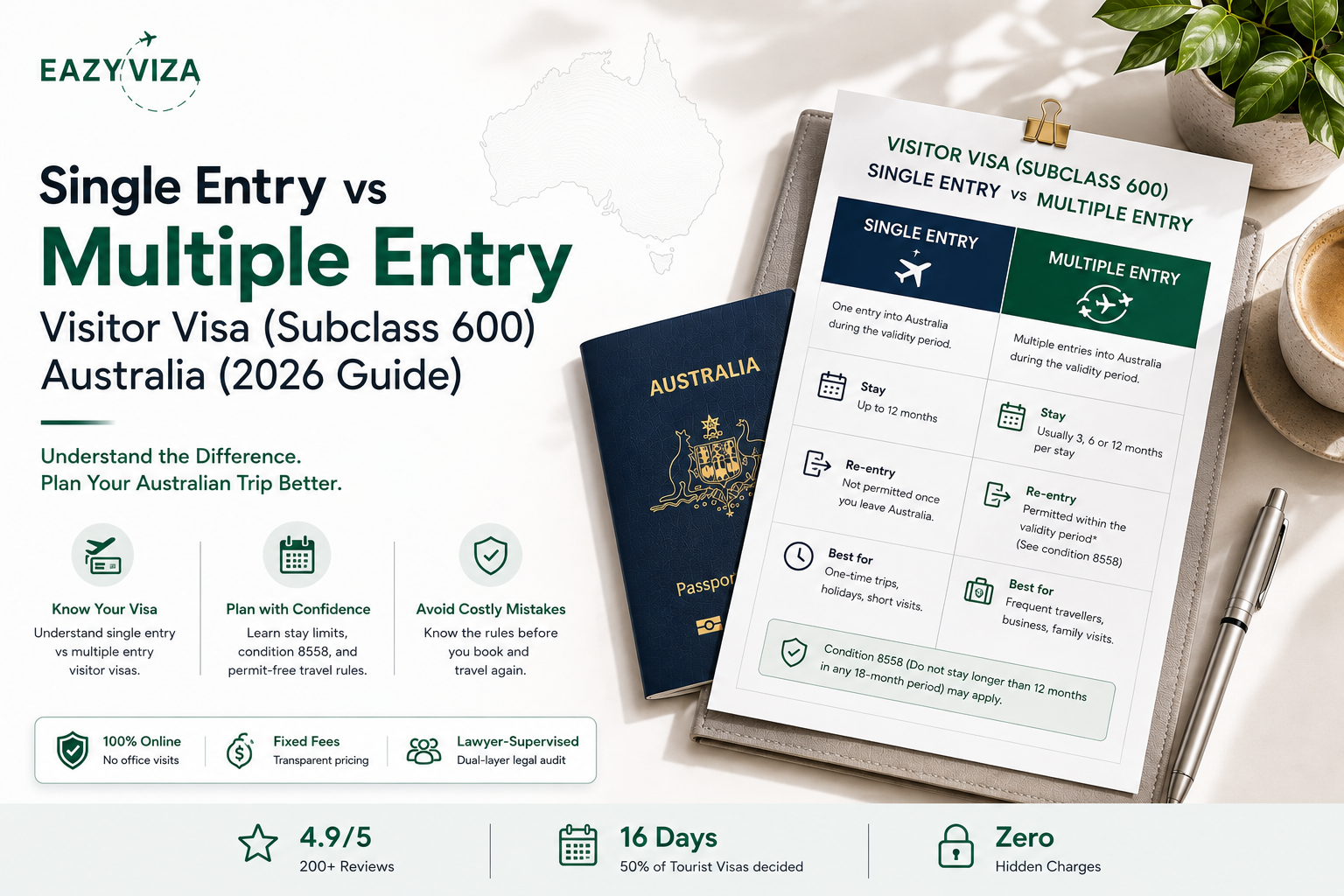
Condition 8558 limits you to a maximum of 12 months in Australia in any rolling 18-month period. It is commonly attached to multiple-entry visitor visa grants. The 18-month window is a rolling, backward-looking calculation, not a timer that restarts on departure. Leaving Australia between visits does not reset it. Border Force calculates your total accumulated days at every new entry. Full detail with a worked timeline is in our multiple-entry guide.
Q12: What happens if I overstay my visitor visa?
You become an unlawful non-citizen from the moment your permitted stay period expires. This can lead to detention and removal. Overstaying also triggers a re-entry ban under PIC 4014 of up to 3 years on future temporary visa applications, and the record attaches permanently to your immigration history. If you are still in Australia past your expiry, applying for a Bridging Visa E may allow you to regularise your status while you arrange departure. Contact our team immediately if this applies to you.
Category 4: Work, Study, and Visa Conditions
Q13: Can I work on a visitor visa in Australia?
No. Condition 8101 (No Work) is mandatory on all Subclass 600 Tourist, Sponsored Family, and Business Visitor stream grants. It prohibits paid employment, freelancing, and commercial services for Australian businesses. Remote work for an overseas employer is generally tolerated under Home Affairs administrative policy if it is incidental to your visit and paid offshore, but this is policy guidance, not legislation. For the full breakdown of what counts as work and what does not, see our Condition 8101 guide.
Q14: Can I study on a visitor visa in Australia?
Yes, but only for a maximum of 3 months. Condition 8201 (Maximum three months study) is attached to every standard visitor visa grant and allows short courses, language programs, or part of a longer qualification up to that limit. For formal study longer than 3 months in a CRICOS-registered course, a Student Visa (Subclass 500) is required. A visitor visa cannot substitute for a student visa regardless of the course length.
Q15: What is condition 8503 and which visitor visas carry it?
Condition 8503 (No Further Stay) prevents you from applying for most other visas while you are in Australia. It is applied by default to Sponsored Family and Business Visitor stream grants. The Tourist stream may also carry it, particularly for onshore applications or higher-risk cases. A waiver is possible only if compelling or compassionate circumstances arose after the visa was granted, not for circumstances that existed before. The eVisitor (651) and ETA (601) never carry condition 8503. Source: Home Affairs, Visitor Visa (600).
Q16: Can I change to another visa while I am in Australia on a visitor visa?
It depends on whether condition 8503 is on your current grant. If 8503 applies, you generally cannot apply for most other visas while in Australia and must depart and apply offshore. If 8503 is not on your grant, certain onshore applications may be possible, with the Partner Visa (Subclass 820) in a genuine, established relationship being the most common pathway. Most other routes (student, working holiday, most skilled) require departure. See our Partner Visa service if this applies to your situation.
Category 5: Refusals, Special Situations, and Medical or Transit Visits
Q17: What happens if my visitor visa is refused?
You receive a formal written decision stating the reasons. Offshore Tourist stream applicants without an eligible Australian sponsor generally have no Administrative Review Tribunal (ART) review rights even on full refusal, which is why a well-prepared initial application is the most important protection available. If a review is available, strict timeframes apply and missing them removes the right to merits review. For help assessing a refusal notice or re-application strategy, see our ART Review Application service.
Q18: Can my visitor visa be cancelled after it has been granted?
Yes. A granted visa can be cancelled under Section 116 of the Migration Act 1958 if you breach your conditions, provide false or misleading information in your application, or if your circumstances change in a way that affects your eligibility. Working in breach of condition 8101, overstaying your permitted period, and undisclosed prior criminal convictions are the most common grounds. Cancellation makes you an unlawful non-citizen immediately. For the full conditions detail, see our Condition 8101 guide.
Q19: Can I visit Australia specifically for medical treatment?
A Subclass 600 Tourist visa can cover a trip that includes medical care, but if the primary purpose of your visit is receiving medical treatment, the Medical Treatment Visa (Subclass 602) is the dedicated pathway. It allows a stay of up to 12 months for treatment, a further 12 months for recovery, and permits the applicant to bring a carer or support person. The Subclass 602 has its own application process through ImmiAccount. Source: Home Affairs, Medical Treatment visa (602).
Q20: Do I need a visa to transit through Australia?
It depends on your passport country and whether you will clear immigration. Many nationalities can transit airside without a visa if they remain in the international departure area and hold a confirmed onward ticket. If you must pass through Australian immigration clearance during your transit, you need either a valid visitor visa or the Transit Visa (Subclass 771), which is a free, short-duration visa for passengers who must enter Australia briefly during a transit. Check the Home Affairs Transit visa page for eligibility by passport country.
Complete Visitor Visa (Subclass 600) Cluster
Every spoke in this cluster is listed below. Each covers one topic in full depth. If an answer above links to a guide and you want to read the complete version, find it here.
All streams, fees, eligibility, and how to apply — the starting point for every application.
What "no work" actually means, the remote work policy, and what happens if you breach it.
Free templates for direct family and cousins, Form 1149 explained, and the GTE red flags.
Eligibility by passport, fee comparison, stay limits, and the criminal conviction rule.
Decision-ready file building for Tourist, Sponsored Family, and Business Visitor streams.
Condition 8558, the rolling 18-month rule, and the bilateral 3-year arrangement for India.
Why you cannot choose a duration, what each length of stay requires, and the consistency test.
India-specific documents by applicant profile, the lump sum trap, and biometrics explained.
Last reviewed: 25 August 2026. Verified against Migration Regulations 1994 (clause 600.211, Schedule 8 conditions 8101, 8201, 8503, 8558), Migration Act 1958 (Section 116), and Home Affairs Visitor Visa (Subclass 600) page. Always check the live Home Affairs website before lodging, as conditions and fees can change.
Frequently asked questions
Who can apply for the Subclass 600 Tourist visa?
Any person of any nationality can apply for the Subclass 600 Tourist stream from outside or inside Australia. There are no passport-based restrictions, which sets it apart from the eVisitor (651) and ETA (601), which are limited to holders of specific European or other designated passports.
Can I apply for a visitor visa while I am already in Australia?
Yes. The Tourist stream (onshore) is a separate sub-stream for applicants already in Australia on a current, lawful visa. You apply through ImmiAccount from within Australia. Before lodging, check your current visa grant notice. If condition 8503 (No Further Stay) appears, you generally cannot apply for another visa onshore.
Can I bring my spouse and children on my visitor visa?
No visitor visa covers dependants. Each family member, including children, needs their own separate Subclass 600 application. Every applicant must independently satisfy clause 600.211 of the Migration Regulations 1994, the genuine visitor intent requirement. Each family member's grant, conditions, and length of stay are assessed and issued individually.
Can I apply for a visitor visa if I have a previous visa refusal on record?
Yes, but the refusal must be declared in your new ImmiAccount application. Failure to declare a previous refusal from any country can constitute misleading conduct under PIC 4020 and is itself grounds for a new refusal. A re-application must specifically address the reasons stated in the original decision notice.
How much does the Subclass 600 Tourist visa cost in 2026?
The base application charge for the offshore Tourist stream is AUD 250 from 1 July 2026, paid through ImmiAccount and non-refundable even if refused. Sponsored Family and Business Visitor streams start at the same base rate. The Frequent Traveller stream costs AUD 1,845. Confirm the current amount using the Home Affairs Visa Pricing Estimator before paying.
How long does it take to get a visitor visa decision?
Current global benchmarks show a median of around 16 days for the offshore Tourist stream, with 90% of applications decided within 33 days. The Sponsored Family stream takes longer: median 38 days, 90th percentile 79 days. Applications that are complete and consistent at lodgement process faster because no Request for Further Information is needed.
How do I check my visa conditions after it is granted?
Use the Visa Entitlement Verification Online (VEVO) tool at immi.homeaffairs.gov.au. VEVO shows your visa subclass, grant date, arrival deadline, length of stay, and every condition attached to your current visa. You need your passport number and visa grant number from your grant notice to log in.
What is the difference between my grant date, the "must not arrive after" date, and my length of stay?
Three separate fields on every grant notice. The grant date is when the decision was made. The "must not arrive after" date is the last day you can enter Australia on that visa. The length of stay is how long you may remain after each entry, commonly 3 months. You can arrive right up to the arrival deadline and still stay for the full permitted period.
Can I stay longer than 3 months on a visitor visa?
A 3-month length of stay per visit is the default for most first-time applicants, but grants of 6 or 12 months are possible depending on circumstances and what your documents support. The case officer decides at grant. There is no field in ImmiAccount where you select a preferred duration.
Can I extend my visitor visa while I am in Australia?
The length of stay on a granted Subclass 600 visa cannot be extended. If you need more time, you must either depart before your permitted stay expires or lodge a new substantive visa application from within Australia, provided condition 8503 is not on your current grant. If 8503 is present, you generally must depart and apply from outside Australia.
What is condition 8558 and does leaving Australia reset the 18-month clock?
Condition 8558 limits you to a maximum of 12 months in Australia in any rolling 18-month period. It is commonly attached to multiple-entry grants. The 18-month window is a rolling, backward-looking calculation. Leaving Australia between visits does not reset it. Border Force calculates your total accumulated days at every new entry.
What happens if I overstay my visitor visa?
You become an unlawful non-citizen from the moment your permitted stay period expires. This can lead to detention and removal. Overstaying triggers a re-entry ban under PIC 4014 of up to 3 years on future temporary visa applications, and the record attaches permanently to your immigration history. If still in Australia, applying for a Bridging Visa E may allow you to regularise your status while arranging departure.
Can I work on a visitor visa in Australia?
No. Condition 8101 (No Work) is mandatory on all Subclass 600 Tourist, Sponsored Family, and Business Visitor stream grants. It prohibits paid employment, freelancing, and commercial services for Australian businesses. Remote work for an overseas employer is generally tolerated under Home Affairs administrative policy if incidental to the visit and paid offshore, but this is policy guidance, not legislation.
Can I study on a visitor visa in Australia?
Yes, but only for a maximum of 3 months. Condition 8201 (Maximum three months study) is attached to every standard visitor visa grant. For formal study longer than 3 months in a CRICOS-registered course, a Student Visa (Subclass 500) is required. A visitor visa cannot substitute for a student visa regardless of course length.
What is condition 8503 and which visitor visas carry it?
Condition 8503 (No Further Stay) prevents you from applying for most other visas while in Australia. It is applied by default to Sponsored Family and Business Visitor stream grants. The Tourist stream may also carry it, particularly for onshore applications or higher-risk cases. A waiver is possible only for compelling or compassionate circumstances that arose after the visa was granted. The eVisitor (651) and ETA (601) never carry condition 8503.
Can I change to another visa while I am in Australia on a visitor visa?
It depends on whether condition 8503 is on your current grant. If 8503 applies, you generally cannot apply for most other visas while in Australia and must depart and apply offshore. If 8503 is not on your grant, certain onshore applications may be possible. The Partner Visa (Subclass 820) in a genuine, established relationship is the most common viable pathway. Most other routes require departure.
What happens if my visitor visa is refused?
You receive a formal written decision stating the reasons. Offshore Tourist stream applicants without an eligible Australian sponsor generally have no Administrative Review Tribunal (ART) review rights even on full refusal, which is why a well-prepared initial application is the most important protection. If a review is available, strict timeframes apply and missing them removes the right to merits review.
Can my visitor visa be cancelled after it has been granted?
Yes. A granted visa can be cancelled under Section 116 of the Migration Act 1958 if you breach conditions, provide false or misleading information, or if your circumstances change in a way that affects eligibility. Working in breach of condition 8101, overstaying, and undisclosed prior criminal convictions are the most common grounds. Cancellation makes you an unlawful non-citizen immediately.
Can I visit Australia specifically for medical treatment?
A Subclass 600 Tourist visa can cover a trip that includes medical care, but if the primary purpose is receiving treatment, the Medical Treatment Visa (Subclass 602) is the dedicated pathway. It allows up to 12 months for treatment and a further 12 months for recovery, and permits a carer or support person to accompany the applicant.
Do I need a visa to transit through Australia?
It depends on your passport country and whether you will clear immigration. Many nationalities can transit airside without a visa if they remain in the international departure area and hold a confirmed onward ticket. If you must pass through Australian immigration clearance during transit, you need either a valid visitor visa or the Transit Visa (Subclass 771), which is free and short-duration.