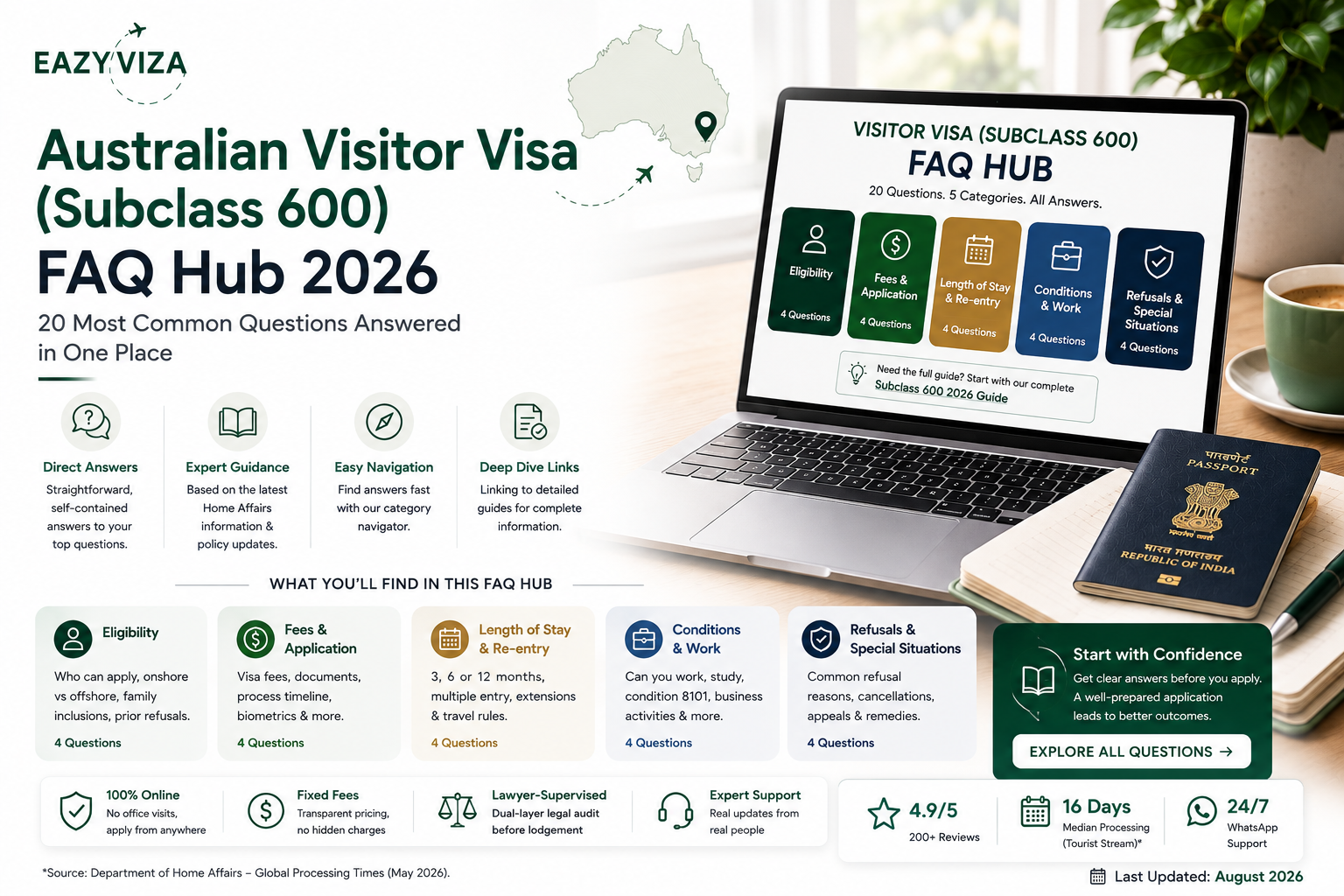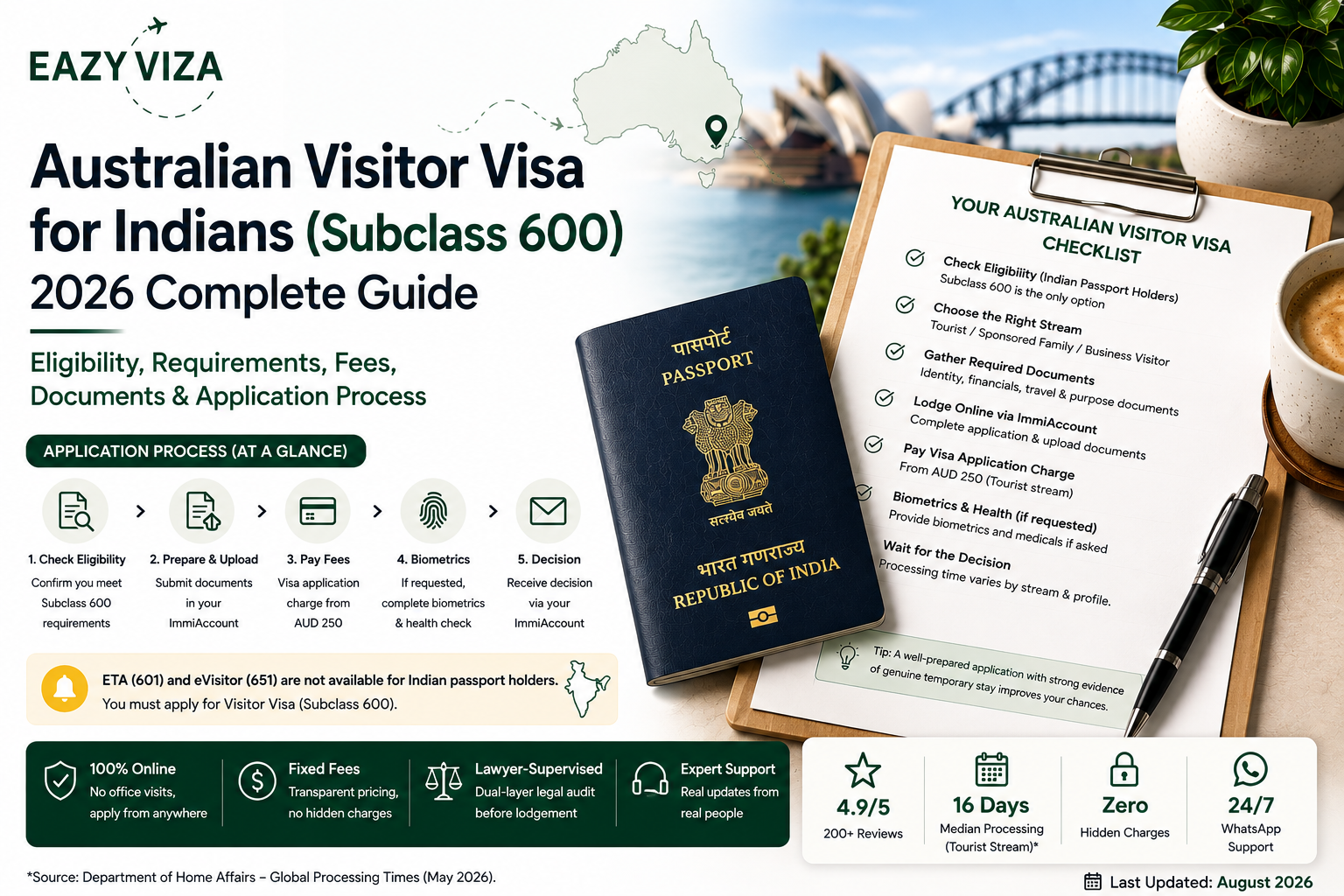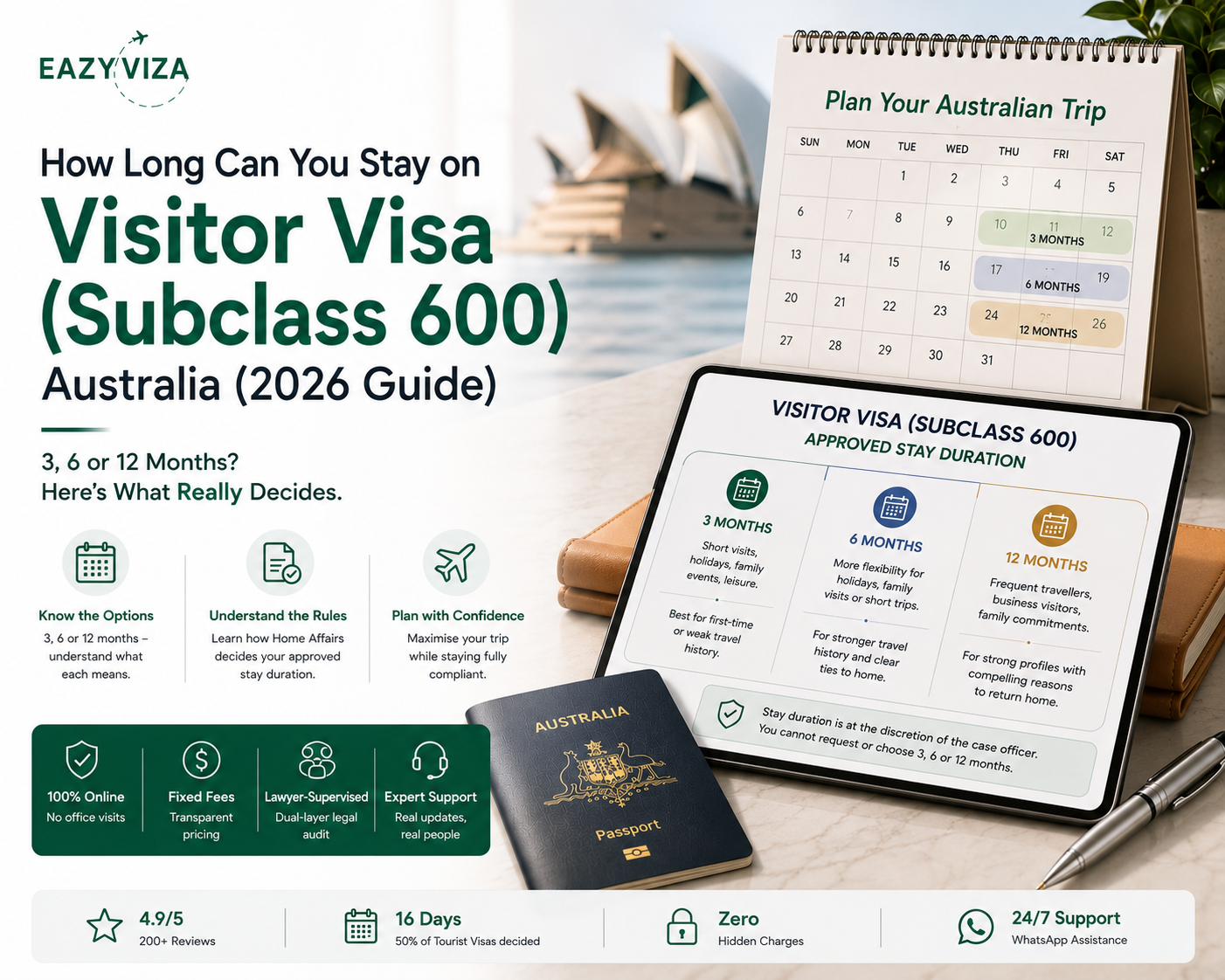
Before you open ImmiAccount and start uploading, it helps to understand what a case officer actually does with your file. Under clause 600.211 of the Migration Regulations 1994, their job is to assess whether you genuinely intend to visit Australia temporarily. They read your file as one connected story. If that story holds together, a decision comes quickly. If something does not add up across your documents, you receive a Request for Further Information (RFI), which extends your wait and signals that the officer is looking harder. Building what Home Affairs calls a "decision-ready" file from the start is the single most useful thing you can do before you lodge. For the full breakdown of streams, fees, and eligibility, see our Australian Visitor Visa (Subclass 600) 2026 guide.
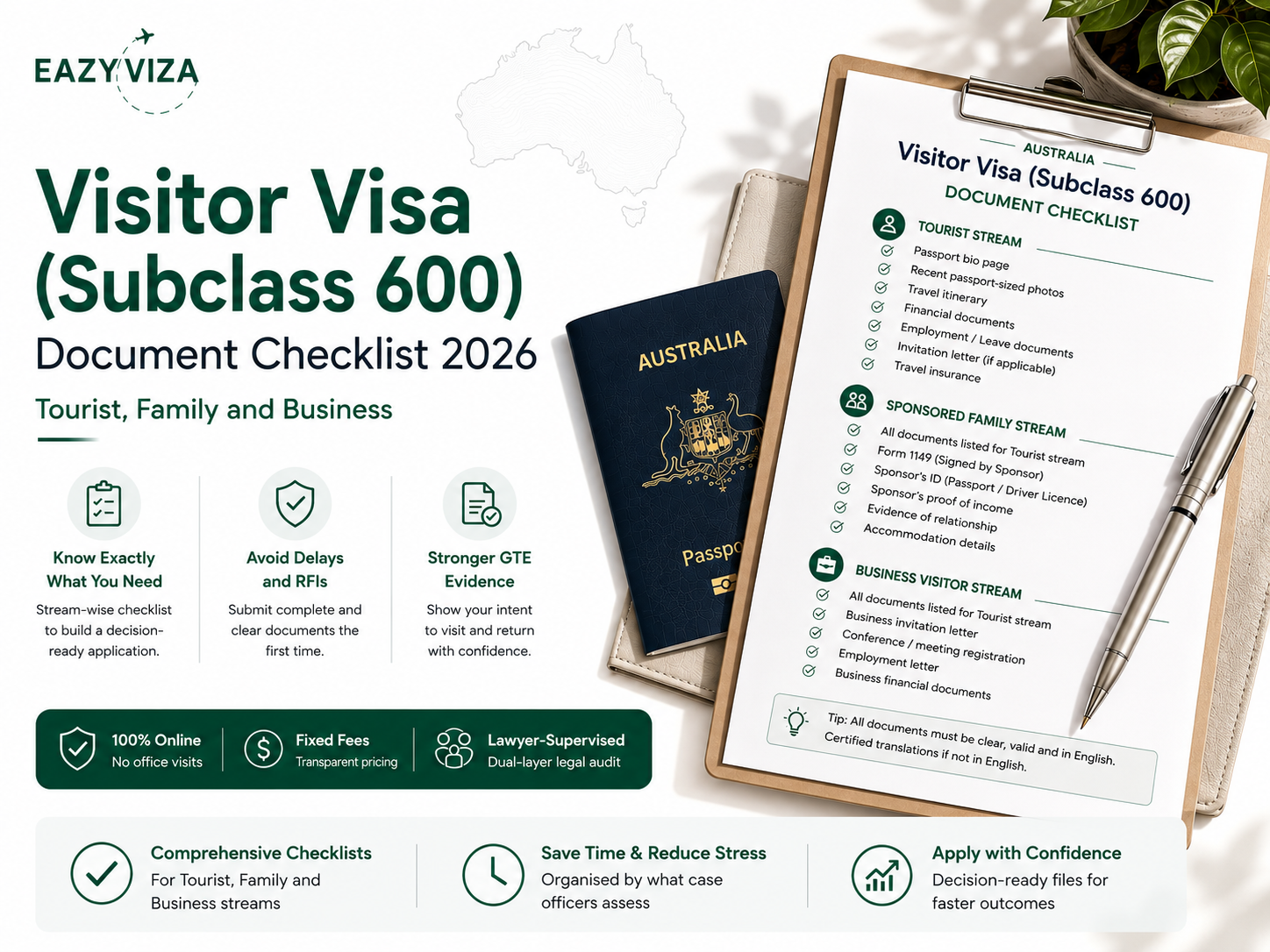
Quick answer: The documents you need depend on your stream. Tourist stream applicants focus on financial evidence and ties to home. Sponsored Family stream applicants need both their own documents and their Australian sponsor's. Business Visitor applicants need to prove a short-term business activity paid by an employer at home. All three are covered below, with the printable tick-off version in our Visitor Visa Toolkit.
Which Stream Are You Applying Under?
Your stream is selected at the very start of your ImmiAccount application and it is difficult to change once you begin. Picking the wrong one means attaching the wrong evidence and asking the officer to assess you against the wrong criteria. Confirming your stream before you open the form is worth two minutes of your time.
Tourist Stream
You are planning a holiday, a cruise, or a casual visit to friends or family. Nobody in Australia is formally sponsoring your trip with a legal undertaking.
Sponsored Family Stream
A relative in Australia is formally sponsoring your visit. This means they have lodged a separate sponsorship application and taken on a legal responsibility for your compliance.
Business Visitor Stream
You are attending a conference, a meeting, or a negotiation. You remain on your home-country salary for the full duration of the trip and no Australian entity is paying you.
What a Case Officer Is Actually Assessing
Need expert guidance?
Speak with a migration specialist
Get personalised advice on your visa pathway — response within 2 hours.
Every document you attach is answering one of three questions a case officer works through under clause 600.211 of the Migration Regulations 1994. Once you understand those questions, the reason each document category exists becomes clear, and you can judge for yourself whether your file is strong enough before you lodge.
Documents Every Stream Needs
Regardless of which stream you are applying under, these go into every Subclass 600 application. Getting any of them wrong is the most avoidable source of processing delays.
| Document | What it proves to the case officer | Most common mistake |
|---|---|---|
| Passport bio page, colour scan | Identity and travel document validity | Black and white scan; expiry date not checked against return travel date |
| Name consistency across all documents | You are the same person in every file attached | Autocorrect changes a name in one field. Home Affairs flags this explicitly in their lodgement guidance. |
| All previous names declared | No gaps in your immigration history | Married name on the application, maiden name on bank statements |
| Travel history | Credibility of your travel purpose and character | Omitting countries where you previously had visa issues |
| Health and character declarations | You meet the health and character requirements | Leaving fields blank rather than answering No |
| English translation of non-English documents | The case officer can read every document you have attached | Google Translate screenshots; no translator credentials included |
| Form 956 (if using a migration agent) | Authorises your agent to communicate with Home Affairs on your behalf | Agent lodges without a signed Form 956 attached to the file |
On translations: Every non-English document needs a translation attached alongside the original. For translators based in Australia, include their NAATI (National Accreditation Authority for Translators and Interpreters) practitioner number. For translators based outside Australia, include their full name, address, phone number, and qualifications in the language they are translating from. Google Translate is not accepted. Source: Home Affairs, Applying for a visitor visa, Check Twice Submit Once.
Tourist Stream: What Goes Into Your File
Your whole tourist stream file is making one argument across three layers of the pyramid above. Start with financial evidence, build to ties, and finish with itinerary.
Passport and identity. Colour scan of the photo page. Check the expiry date against your planned departure from Australia, not your arrival date.
Financial evidence. Bank statements covering the last 3 to 6 months. What matters is not just the balance on the day you apply, but the pattern across those months. Regular salary credits, consistent savings, and a balance that makes sense for the length and cost of your trip are what the officer is reading. The detail on unexplained deposits is covered in its own section below.
Evidence of ties to home. This is the layer that proves you will leave. An employment letter showing your position, salary, and the specific approved leave dates is the clearest form. Property documents, lease agreements, your children's school enrolments, or confirmation of a spouse remaining at home all count. The more specific and verifiable, the stronger the argument. Source: Home Affairs, Check Twice Submit Once.
Travel itinerary. Day-by-day planning is not required, but the dates in your itinerary must match every other document you attach. If your leave approval says one range and your itinerary says another, that inconsistency is exactly what gets flagged.
Return or onward travel booking. A held booking or a confirmed travel plan is generally enough. You do not need a non-refundable ticket before your visa is granted.
If you are self-employed
- Business registration certificate or GST/trade licence equivalent
- Income Tax Returns for the last 2 to 3 financial years
- Business bank statements alongside personal bank statements
- Chartered Accountant letter confirming income and business continuity
- A letter explaining how your business operates in your absence
If you are retired
- Pension certificate or EPF/NPS statement confirming regular income
- Fixed deposit certificates or savings account evidence
- Property title documents showing assets in your home country
- Adult child's employment letter as a substitute ties document
- Family commitments remaining at home (spouse, dependants)
For the Tourist stream checklist in printable, tick-off format, see page 3 of our Visitor Visa Toolkit.
Sponsored Family Stream: Two People, One File
The Sponsored Family stream is different from the Tourist stream in one important way: a case officer reads it as a file covering two people, you and your Australian sponsor. If the evidence on your side says one thing and the evidence on their side says another, that gap is exactly what gets noticed.
What your Australian sponsor needs to provide. Their formal sponsorship application (not just a personal invitation letter), proof of Australian citizenship or permanent residency, proof of settled residence in Australia, and financial evidence if they are claiming to cover your costs. The sponsorship is a formal step separate from the invitation letter. A warm personal letter on its own does not constitute sponsorship. Source: Home Affairs, Sponsored Family stream (Subclass 600).
What you need to provide. Everything in the Tourist stream document set, plus proof of your relationship to the sponsor (birth certificates, marriage certificate, or other official family documents), and a properly structured invitation letter covering relationship, purpose, exact dates, accommodation, and who is paying for what. For the exact format that letter should take, how Form 1149 works, and what counts as valid sponsorship paperwork, see our Invitation Letter and Form 1149 guide.
Financial evidence must match across both sides. If the application says the sponsor is covering all costs, their bank statements must show they can. If you are self-funding, yours must show it. A claim on one side with evidence only on the other is the single most common reason Sponsored Family applications stall. Source: Home Affairs, Sponsored Family stream.
For the Sponsored Family stream checklist in tick-off format, see page 4 of our Visitor Visa Toolkit.
Business Visitor Stream: One File, One Argument
Your whole Business Visitor file has one job: show that this is a short, legitimate business activity and that you remain paid by your employer at home throughout the trip. Every document you attach should support that argument and nothing else.
Letter from the Australian business, on company letterhead, naming you by name, stating the specific dates and the specific activity (conference name, meeting purpose, contract being negotiated), and including a named contact the case officer could call. "Business development" is too vague.
Your employer letter from home, confirming your position, your salary, and that you remain employed and paid by them for the full duration of the trip. This draws the line between a permitted business visit and anything that could constitute work in Australia. For the exact boundary between permitted business activity and prohibited work under Condition 8101, see our Condition 8101 guide.
Consistent dates across everything. Your invitation or conference registration, flights, and accommodation should all tell the same story about when you arrive and when you leave.
For the Business Visitor checklist in tick-off format, see page 5 of our Visitor Visa Toolkit.
The Bank Statement Rule Most Applicants Miss
Consistent transaction history over 3 to 6 months, not just a high balance on the day you apply. Regular income credits, predictable spending, and a balance that makes sense for your stated income level are what an officer reads. The balance alone tells a smaller story than the pattern behind it.
No unexplained lump sums shortly before lodging. A sudden large deposit without a traceable source raises the question of whether funds were borrowed, transferred temporarily, or arranged to look larger than they are. A January 2025 visitor visa refusal (client Kamal Singh, application ID 1910696503, decided under clause 600.211) cited insufficient evidence of financial and employment ties to India. The financial evidence was present, but the pattern was inconsistent with the declared income level.
The one-paragraph test. If the source of any large deposit cannot be explained in one sentence with two supporting documents, do not count that deposit as part of your available funds in your application.
There is no minimum bank balance published by Home Affairs for the Subclass 600 Tourist visa. Financial sufficiency is assessed relative to your planned stay length, your itinerary, and who is covering which costs. Any specific dollar figure you see quoted on a third-party website is an estimate, not a government requirement. Source: Home Affairs, Applying for a visitor visa.
Special Situations Worth Knowing
Travelling with a child under 18
If a child is included in the application and their parents or guardians are not travelling with them, two specific forms are required. Form 1229 is the consent form that parents or guardians must sign to authorise the visa grant. Form 1257 is the undertaking declaration required when the child will be staying with someone who is not a relative or legal guardian. You also need a birth certificate showing both parents' names and, where applicable, proof of guardianship. Source: Home Affairs, Check Twice Submit Once; Form 1229 (PDF, Home Affairs); Form 1257 (PDF, Home Affairs).
If you have a previous visa refusal
You must declare every prior visa refusal or cancellation from any country, including Australia, the UK, Canada, the USA, or any Schengen state, when completing your ImmiAccount form. Omitting a previous refusal can constitute misleading conduct under Public Interest Criterion (PIC) 4020 of the Migration Regulations 1994, which is separate grounds for refusal and follows every future application you make.
A previous refusal does not stop you re-applying. What it means in practice is that your new file needs to specifically address the reasons stated in the original decision notice, not just resubmit the same documents. If the timeframe allows, a formal Administrative Review Tribunal (ART) review is also available.
Had a visitor visa refused?
Our lawyer-supervised team can read the decision record, identify exactly what the officer was not satisfied with, and prepare a re-application that addresses those gaps directly, or lodge an Administrative Review Tribunal (ART) review if the timeframe allows. Fixed pricing, file start within 24 to 48 hours.
Want a printable tick-off version of all three checklists?
The Australian Visitor Visa Toolkit covers Tourist, Sponsored Family, and Business Visitor stream checklists in full, including the most avoidable refusal reasons in at-a-glance format. It is free, sent to your inbox, and built specifically for applicants from India, the Philippines, and Sri Lanka. This blog explains why each document matters. The Toolkit is what you use while actually preparing them.
Last reviewed: 16 August 2026. Verified against Migration Regulations 1994 (clause 600.211), Home Affairs Check Twice Submit Once guidance, and Form 1229/1257 current versions. Always check the live Home Affairs website before lodging as requirements and forms can change.
Frequently asked questions
How many months of bank statements do I need for an Australian visitor visa?
Home Affairs does not publish a fixed minimum. Most applications include 3 to 6 months of statements. What matters more than the number of months is the consistency of the transactions: regular income credits, predictable spending, and a balance that makes sense for your stated income and planned stay. Three months of stable, regular income history is more persuasive than 12 months with one unexplained large deposit.
Can I use my Australian sponsor's or child's bank statements instead of my own?
Yes, if your sponsor is covering the costs of your trip, their financial evidence carries significant weight. But the application must clearly state who is paying for what, and the evidence must match that declaration. If the form says the sponsor is covering costs but the bank statements attached are only yours, that mismatch is one of the most common reasons Sponsored Family files stall. Both sides need to tell the same story.
Is there a minimum bank balance required for an Australian visitor visa?
No. Home Affairs does not publish a minimum balance for the Subclass 600 Tourist or Sponsored Family stream. Financial sufficiency is assessed relative to your planned stay length, your itinerary, and who is covering which costs. Any specific dollar figure quoted on a third-party website is an estimate, not a government requirement.
Do I need a return ticket booked before I apply for an Australian visitor visa?
No. A held booking or a confirmed travel plan is generally sufficient. You are not required to purchase a non-refundable ticket before your visa is granted. Home Affairs wants evidence of your intention to leave Australia before your visa expires, not proof you have committed money to flights.
What if my documents are not in English?
Every non-English document must have an English translation attached alongside the original. For translators based in Australia, include their NAATI practitioner number. For translators based outside Australia, include their full name, address, phone number, and qualifications in the language they are translating from. A Google Translate screenshot is not accepted.
Does a previous visa refusal affect my Australian visitor visa application?
You must declare every previous refusal from any country on your ImmiAccount form. Failing to declare one is itself grounds for refusal under PIC 4020 of the Migration Regulations 1994. A previous refusal does not prevent you from re-applying, but your new application needs to specifically address the reasons stated in the original decision notice.
What documents do retired parents need for an Australian visitor visa?
Retired applicants cannot provide an employer leave letter, so the ties evidence shifts to other documents: pension or superannuation statements, fixed deposit certificates, property title documents showing assets in the home country, and evidence of family commitments remaining at home. An adult child's employment letter showing their own approved leave can support the ties argument.
Can self-employed people get an Australian visitor visa?
Yes. Self-employed applicants need a different financial document set: business registration or trade licence, income tax returns for 2 to 3 years, business and personal bank statements, and ideally a Chartered Accountant letter confirming income and continuity of the business during the trip.
Do I need to show property documents for an Australian visitor visa?
Property documents are not mandatory, but they are strong evidence under the ties-to-home layer of the GTE assessment. A property title, mortgage statement, or lease agreement in your name shows the case officer you have a concrete financial and personal stake in returning. For retired applicants or those with limited employment history, property documents often carry more weight than any other single document.