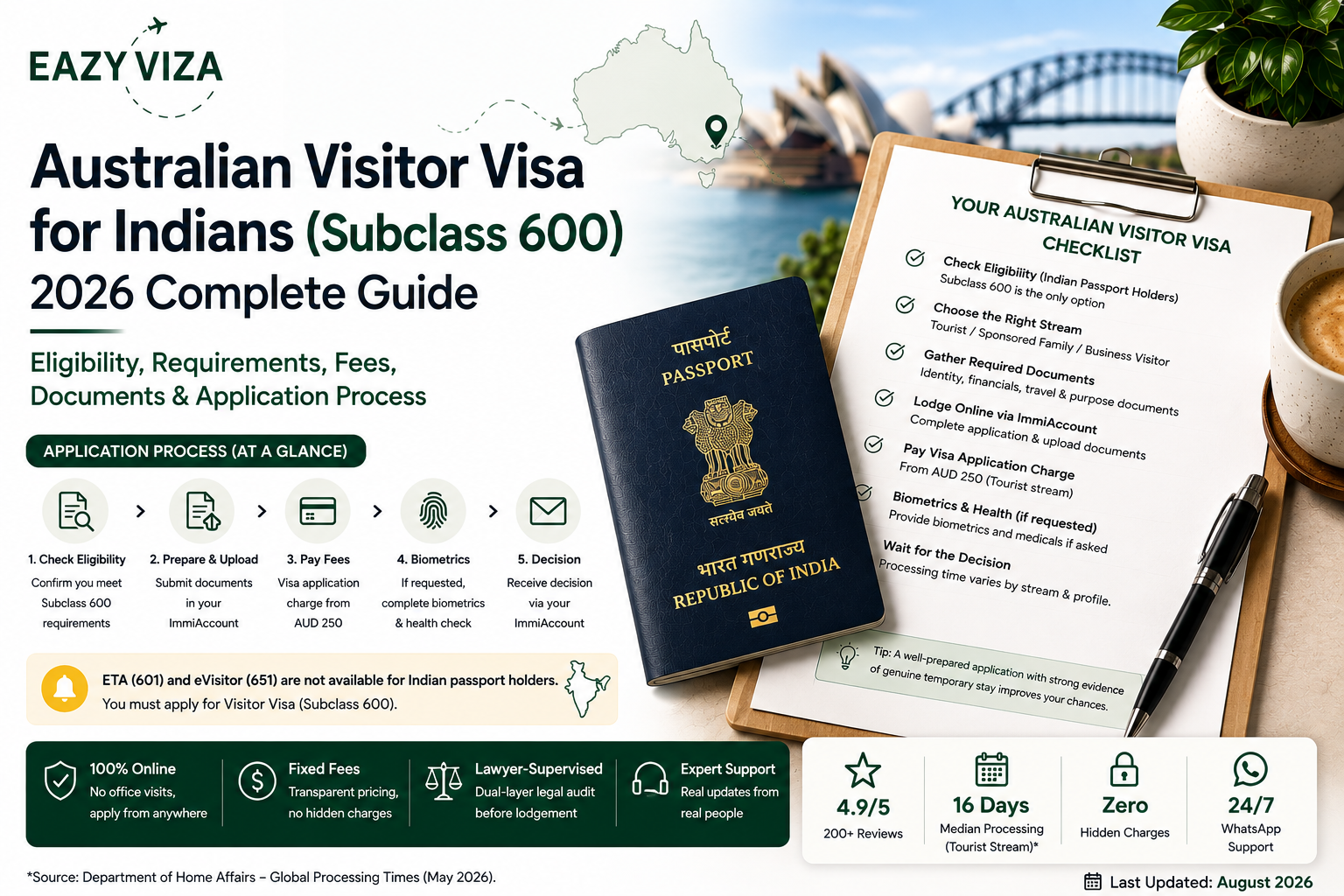
Indian passport holders have one path to Australia as a visitor: the Visitor Visa (Subclass 600). The Electronic Travel Authority (Subclass 601) and the eVisitor (Subclass 651) are both unavailable to Indian nationals — see our eVisitor vs Subclass 600 guide for a full breakdown of who qualifies for those alternatives. For the general Subclass 600 overview covering all nationalities, fees, streams, and how to apply, see our Australian Visitor Visa (Subclass 600) 2026 guide. This guide covers specifically what is different about applying from India: the documents that matter, the financial evidence patterns that get applications refused, the personal statement format, and the biometrics process as it actually works for Indian applicants.
Key facts for Indian applicants: The base visa application charge is AUD 250 (offshore, from 1 July 2026). Applications are lodged entirely online through ImmiAccount at immi.homeaffairs.gov.au. No embassy interview is required. Biometrics are not routinely required but may be requested. The median processing time for the Tourist stream is around 16 days, with 90% of applications decided within 33 days. India is part of a bilateral arrangement that positions strong, compliant applications for 3-year multiple-entry grants. Most first-time Indian applicants receive a 3-month grant.
Which Stream Applies to Your Trip
The stream is selected at the start of your ImmiAccount application and cannot be changed once lodged. Most Indian applicants use the Tourist stream. The Sponsored Family stream applies only when an eligible Australian citizen or permanent resident has formally lodged sponsorship, not simply written a letter. If you are visiting family in Australia but no formal sponsorship has been lodged, you are applying under the Tourist stream even if the sole purpose of your trip is a family visit.
Your Document Set Depends on Your Applicant Profile
Need expert guidance?
Speak with a migration specialist
Get personalised advice on your visa pathway — response within 2 hours.
Case officers assess Indian applications against clause 600.211 of the Migration Regulations 1994, which requires genuine visitor intent to stay temporarily in Australia. What constitutes strong evidence varies significantly by employment type and family situation. Use the profile that matches you.
Salaried Professional
- 6 months of bank statements showing regular salary credits (not cash deposits)
- Salary slips for the last 3 to 6 months, ideally showing PF deductions as evidence of formal employment
- Income Tax Return (ITR-V acknowledgement) for the last 2 to 3 financial years — submit through incometax.gov.in
- Leave sanction letter on company letterhead stating your exact return-to-work date, signed by HR or a manager
- Employment confirmation letter naming your position, salary, and the organisation
Self-Employed or Business Owner
- UDYAM Registration Certificate (for MSMEs via udyamregistration.gov.in) or GST Registration Certificate (via gst.gov.in)
- Business current account statements (last 6 months) alongside personal savings account statements
- Business ITR for the last 2 to 3 years, plus personal ITR
- CA-certified Net Worth Statement or Balance Sheet demonstrating ongoing business activity
- A brief explanation of how the business operates during your absence and who manages it
Parents Visiting Children in Australia
- Retirement certificate, pension statement, or EPF/NPS account statement — accessible via epfindia.gov.in for EPF records
- Fixed deposit certificates or savings account statements covering the full intended stay period
- Your child's Australian citizenship, PR grant letter, or current visa grant notice and VEVO confirmation
- Proof of relationship: birth certificate showing your name as parent
- Invitation letter from your child in Australia — for the exact format this letter should take and whether Form 1149 applies, see our Invitation Letter and Form 1149 guide
Indian Living in a Third Country (UAE, Singapore, UK, etc.)
- Valid residence visa or permit for your current country showing legal status there
- Employment proof in your current country of residence (employment letter, work permit, residence permit)
- Ties to your current country of residence: tenancy agreement, utility bills, employer letter confirming you will return to your role
- Ties to India: property documents, family remaining in India, Indian bank account still active
- Both sets of ties must be documented — the case officer assesses whether you have genuine reason to leave Australia from either location
The Financial Evidence Trap That Catches Indian Applicants
The single most consistently cited factor in refusals of Indian Subclass 600 Tourist applications is insufficient evidence of financial and employment ties under clause 600.211 of the Migration Regulations 1994. The Kamal Singh refusal notice (January 2025, application ID 1910696503) states this directly: the applicant did not satisfy clause 600.211 due to "insufficient evidence of financial, employment, or personal ties to India that would ensure his return after the visit." A similar finding appears in the Wali Hassan refusal notice from the same month.
A sudden large deposit into your bank account in the weeks before lodging is one of the clearest red flags a case officer sees in Indian applications. Borrowing funds, selling assets at the last minute, or receiving transfers from family members to boost a balance before applying creates a pattern that contradicts the genuine financial standing your application needs to demonstrate.
What a case officer reads is the consistency of your transaction history over 3 to 6 months: regular salary credits, recognisable spending patterns, and a balance that makes sense for your stated income. A high balance on the day you apply is only persuasive if the months before it tell the same story. For the full document-by-document checklist including what constitutes strong financial evidence, see our Visitor Visa Document Checklist 2026.
Five Refusal Patterns Specific to Indian Applications
These patterns are drawn from publicly available refusal notices for Indian Subclass 600 applicants (January 2025) and from the clause 600.211 assessment framework in the Migration Regulations 1994.
- Weak ties to India under clause 600.211. The most cited reason across Indian refusals. Minimal property, unclear employment status, no family remaining in India, or a leave letter that is too generic to be credible. A one-line leave approval with no return-to-work date does very little.
- Inconsistent dates between leave approval and stated itinerary. If your employer has approved 14 days and your ImmiAccount entry implies a 6-week trip, the case officer is assessing which one to believe about when you are actually returning to work.
- Unexplained or sudden financial deposits. Large credits appearing in the weeks before lodging without any prior consistent history. Particularly common with first-time applicants who consolidate funds specifically for the application.
- Vague trip purpose with no named events, locations, or dates. "Tourism" or "visiting family" without a specific itinerary, named destination cities, or a reason for the stated length of stay invites higher scrutiny under clause 600.211.
- Third-country residents with undocumented ties to both countries. Indian nationals applying from the UAE, Singapore, or the UK without documenting their residence status, employment, or ties in their current country of residence alongside ties to India. Both dimensions need evidence.
Your Personal Statement: A Template for Indian Applicants
This is not the same as the invitation letter. The invitation letter is written by your Australian host — for the exact format that document needs to take, see our Invitation Letter and Form 1149 guide. Your personal statement is your own document, uploaded to ImmiAccount alongside your other evidence. It is not mandatory but it significantly helps your file read as a coherent whole, particularly for case officers handling a high volume of Indian applications.
Paragraph 1: Trip overview
I, [Full Name], holding Indian Passport No. [XXXXXXXX], am applying for a Visitor Visa (Subclass 600, Tourist Stream) to visit Australia from [Arrival Date] to [Departure Date], a total of [X days/weeks]. The purpose of this visit is [specific purpose: e.g., to attend my nephew's graduation ceremony in Melbourne on [date] and to travel to Sydney and the Blue Mountains during the second and third weeks of the trip].
Paragraph 2: Employment and financial capacity
I am currently employed as a [Job Title] at [Company Name], [City, India], where I have worked for [X years]. My monthly salary of [approximate AUD equivalent] is credited directly to my [Bank Name] savings account, evidence of which is provided in the enclosed bank statements for the period [Month Year] to [Month Year]. I have obtained approved leave from [Leave Start] to [Leave End] and am required to return to work on [Return Date]. My Income Tax Returns for the financial years [Year], [Year], and [Year] are attached.
Paragraph 3: Ties to India
My ties to India include [e.g., my ongoing employment as described above / ownership of residential property at [address], documents attached / my spouse and [children] who will remain in India during this trip / my parents who reside with me in [City]]. I am committed to returning to India before the expiry of my visa and have no intention of remaining in Australia beyond the permitted period.
Paragraph 4: Day-by-day itinerary summary
[Days 1 to 7]: Arrival in [City], staying at [Accommodation name or area]. Planned activities: [specific]. [Days 8 to 14]: Travel to [City]. Planned activities: [specific]. [Days 15 to end]: [Return travel / remaining activities]. Return flight to India: [Flight number and date, or held booking reference].
Paragraph 5: Declaration
I confirm that all information provided in this application and in supporting documents is true and accurate. I understand and will comply with all conditions of the visa, including Condition 8101 (No Work). I will depart Australia before the expiry of my permitted stay. For the no-work condition detail, see my awareness noted above and the full explanation at the Condition 8101 guide.
[Full Name] | [Date] | [Contact Number and Email]
Biometrics: What Indian Applicants Actually Need to Do
Biometrics are not a standard required step for Indian Subclass 600 Tourist visa applicants. Most Indian applications are decided without any biometric enrolment. If Home Affairs requires your biometrics, you will receive a formal request letter through your ImmiAccount directing you to attend an Australian Biometric Collection Centre. Only act on that letter — do not book a VFS appointment in advance on the assumption that biometrics are required.
If you do receive the biometrics request, VFS Global operates Australian Biometric Collection Centres in India in the following cities: New Delhi, Mumbai, Chennai, Kolkata, Hyderabad, Bangalore, Ahmedabad, and Jalandhar. Source: Australian High Commission, New Delhi, biometrics page.
Application Steps for Indian Applicants
Use your profile type above — salaried, self-employed, parents, or third-country resident. Confirm all documents cover the same travel period and that names match your passport exactly throughout.
Register at immi.homeaffairs.gov.au. Use an email address you check regularly as all correspondence including any requests and your decision notice will arrive there.
Choose Visitor Visa (Subclass 600), then Tourist stream for most trips. Select Sponsored Family only if your relative in Australia has already lodged formal sponsorship in ImmiAccount.
Enter your intended travel dates accurately. Upload documents as clear colour PDFs. Every document must be in English or accompanied by a translation with the translator's full credentials. For translation requirements, see our Visitor Visa Document Checklist 2026.
AUD 250 (offshore, from 1 July 2026) by international credit or debit card. The charge is non-refundable. Confirm the current amount at Home Affairs Visa Pricing Estimator before paying as the amount is reviewed periodically.
Check your ImmiAccount and email regularly. If you receive a Request for Further Information, respond within the timeframe given. If you receive a biometrics request letter, book a VFS Global ABCC appointment only then. Most Indian Tourist stream applications are decided within 16 to 33 days.
The Bilateral Multiple-Entry Advantage for Indian Nationals
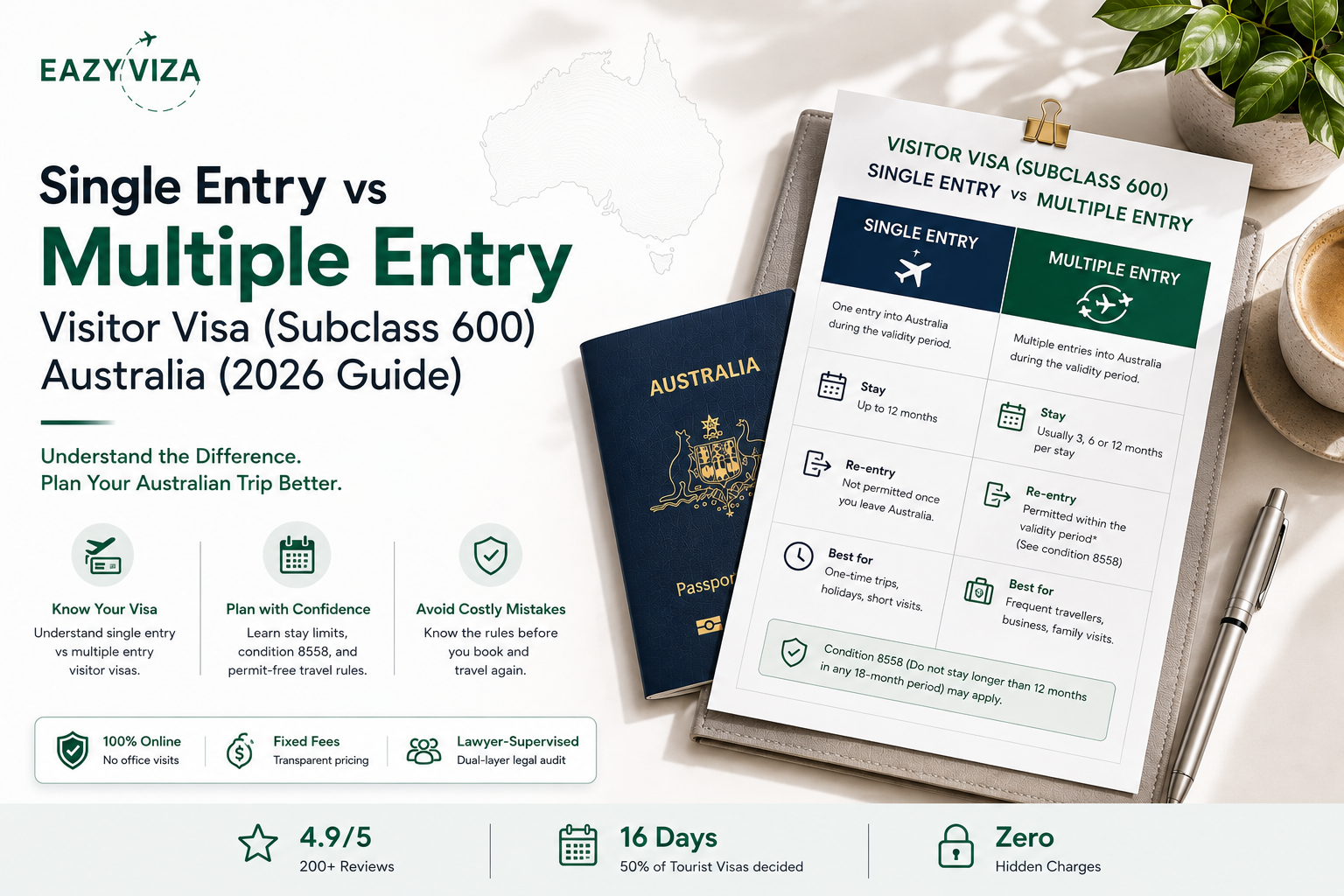
India is part of a bilateral arrangement with Australia that has been active since 2016 and continues into 2026. Strong Indian applications with a clean compliance history on prior grants, consistent travel records, and well-documented ties to India are well-positioned to receive 3-year multiple-entry grants under the standard Tourist stream rather than a short single-entry grant. A first application that is complete, consistent, and decision-ready is the starting point for that trajectory. For how the 3-year grant works in practice and what condition 8558 means for your travel planning, see our Multiple-Entry Visitor Visa guide.
If your first application is straightforward — clear employment, consistent bank history, a specific trip purpose, and matching documents — you can lodge directly through ImmiAccount. If your situation is more complex (previous refusal, self-employment with irregular income, third-country residency, or a stay longer than 3 months needed), our lawyer-supervised Visitor Visa service reviews and prepares your file before lodgement. You can also check your profile strength using our free eligibility checker or estimate the full cost including service fees with our cost calculator.
Last reviewed: 23 August 2026. Fees verified against Home Affairs Visa Pricing Estimator (July 2026). Refusal pattern analysis based on publicly available decision notices (Kamal Singh and Wali Hassan, January 2025). Biometrics guidance sourced from the Australian High Commission, New Delhi. Indian document sources: Income Tax Department of India (incometax.gov.in), UDYAM Registration (udyamregistration.gov.in), GST Portal (gst.gov.in), EPFO (epfindia.gov.in). Always verify current requirements with the Department of Home Affairs before lodging.
Frequently asked questions
Can Indian citizens get an Australian tourist visa?
es. The Visitor Visa (Subclass 600) Tourist stream is the correct pathway for Indian passport holders visiting Australia for tourism, casual family visits, or short business activities. Indian nationals are not eligible for the Electronic Travel Authority (Subclass 601) or the eVisitor (Subclass 651), both of which are limited to passport holders of specific other countries.
What documents do Indian citizens need for an Australian visitor visa?
The document set varies by employment profile. Salaried applicants need 6 months of bank statements showing regular salary credits, salary slips, Income Tax Returns (ITR-V) for 2 to 3 years, and an approved leave letter with a specific return-to-work date. Self-employed applicants need GST or UDYAM registration, business and personal bank statements, business ITR, and a CA-certified Net Worth Statement. Parents visiting children in Australia need pension or retirement proof, the child's Australian status documents, and proof of relationship.
How much does an Australian visitor visa cost for Indian applicants?
The base visa application charge for the Subclass 600 Tourist stream (applied from outside Australia) is AUD 250 from 1 July 2026. This is paid online through ImmiAccount by international credit or debit card and is non-refundable even if the visa is refused. Additional costs may apply if biometrics or a health examination are requested. Confirm the current amount at the Home Affairs Visa Pricing Estimator before paying as charges are reviewed periodically.
How long does an Australian tourist visa take to process from India?
The Department of Home Affairs does not publish India-specific processing times, but the global Tourist stream processing benchmarks show a median of approximately 16 days and 90% of applications decided within 33 days. Applications that are complete and consistent at lodgement process faster because the case officer does not need to issue a Request for Further Information. Always check the live Home Affairs global processing times tool before planning travel, as the figures shift monthly.
Do Indian applicants need biometrics for an Australian visitor visa?
Biometrics are not routinely required for Indian Subclass 600 Tourist visa applicants. If Home Affairs requires your biometrics, you receive a formal request letter through ImmiAccount directing you to attend an Australian Biometric Collection Centre. VFS Global operates these centres in India in New Delhi, Mumbai, Chennai, Kolkata, Hyderabad, Bangalore, Ahmedabad, and Jalandhar. Do not book a VFS appointment in advance on the assumption that biometrics are required.
Why do Australian tourist visa applications get refused for Indian applicants?
The most common reason is insufficient evidence of ties to India under clause 600.211 of the Migration Regulations 1994. Refusal notices for Indian applicants (January 2025) specifically cite "insufficient evidence of financial, employment, or personal ties to India that would ensure return after the visit." Other common reasons include inconsistent dates between the leave approval and the stated itinerary, unexplained large bank deposits shortly before lodging, and vague trip purpose statements without a specific named itinerary.
Can I apply for an Australian tourist visa if I am an Indian living in Dubai or Singapore?
Yes, but your application must document ties to both your current country of residence and India. A UAE-resident Indian applying for an Australian Tourist visa must show the case officer that they have genuine reason to return to the UAE (valid residence visa, employment letter, tenancy agreement) as well as ties to India (property, family, active accounts). Applications from third-country Indian residents that document only one set of ties are frequently refused under clause 600.211.
Can I get a 3-year Australian tourist visa as an Indian citizen?
Yes. India is part of a bilateral multiple-entry arrangement with Australia that has been in place since 2016. Well-prepared Indian applications with consistent bank history, strong ties-to-India evidence, and a clean compliance record from prior Australian travel are positioned for 3-year multiple-entry grants under the standard Subclass 600 Tourist stream. A 3-month first grant with clean compliance is often the starting point that leads to a longer grant on subsequent applications.