The Australian Visitor visa (subclass 600) lets you travel to Australia for tourism, to see family, or for short business activities, for a stay of 3, 6 or 12 months depending on your circumstances (Department of Home Affairs, Visitor visa subclass 600). Most applicants use one of three streams: Tourist, Sponsored Family or Business Visitor. Two narrower streams exist for frequent travellers from a short list of countries and for approved group tours from China.
This guide covers what each stream requires, how to actually lodge the application in ImmiAccount, whether you can work on a visitor visa, how eVisitor (651) differs from subclass 600, and what's different if you're applying from India, the Philippines or Sri Lanka.
Key Takeaways
- Visitor visa australia 600 covers three main streams: Tourist, Sponsored Family and Business Visitor, each with different sponsor and evidence requirements (Home Affairs).
- Condition 8101 applies to almost every visitor visa grant and means you cannot work in Australia on this visa (Home Affairs, work restrictions).
- You apply through ImmiAccount, and your application isn't processed until the fee is paid, so document readiness before you start the form matters more than speed once you're inside it (Home Affairs, Apply and manage your application).
- Sponsored Family applicants, common among Indian and Sri Lankan families visiting relatives, need a formal sponsorship application from their Australian sponsor, and in some cases a security bond set case by case (Home Affairs, Sponsored Family stream).
- The Frequent Traveller stream, granted for up to 10 years, is open to citizens of China, Brunei, Cambodia, the Philippines, Laos, Indonesia, Malaysia, Singapore, Thailand, Vietnam and Timor-Leste, not India or Sri Lanka (Home Affairs, Frequent Traveller stream).
The Three Streams: Tourist, Sponsored Family, Business Visitor
The Tourist stream is for holidays, seeing family and friends informally, or short cruises, and is the most common entry point for first-time applicants (Home Affairs, Tourist stream). The Sponsored Family stream is for people sponsored, usually by a family member living in Australia, specifically to visit that family member (Home Affairs, Sponsored Family stream). The Business Visitor stream covers short trips for business enquiries, contract negotiation, conferences and trade fairs, but not ongoing work (Home Affairs, Business Visitor stream). A fourth, narrower stream, Approved Destination Status, exists only for group tours from China organised through an approved travel agent.
| Stream | Purpose | Typical stay | Sponsor required |
|---|---|---|---|
| Tourist | Holiday, casual family visits, cruise | 3, 6 or 12 months, set case by case | No formal sponsor, but must show funds and home ties |
| Sponsored Family | Specific visit to a family member in Australia | Set case by case | Yes, Australian sponsor completes a formal sponsorship application |
| Business Visitor | Enquiries, negotiations, conferences, official visits, not paid work | Matched to the business activity, usually short | No family sponsor, but an invitation letter from the Australian business is standard |
Can You Work on a Visitor Visa? (Condition 8101)
Need expert guidance?
Speak with a migration specialist
Get personalised advice on your visa pathway — response within 2 hours.
No. Nearly every visitor visa is granted subject to condition 8101, which means you're not permitted to work in Australia for the life of the visa (Home Affairs, visa conditions list). This isn't a soft guideline. It covers paid employment of any kind, and Home Affairs treats even informal or "trial" paid work as a breach that can affect future visa applications (Home Affairs, work restrictions). Business Visitor stream activities like attending meetings or signing a contract are allowed precisely because they aren't employment. If your actual purpose in Australia is to work, the visitor visa is the wrong pathway, and applying for one anyway risks a refusal for not meeting the genuine temporary entrant requirement.
eVisitor (651) vs Subclass 600: Which One Do You Need
The eVisitor (subclass 651) is a free, electronically linked visa available only to eligible passport holders, mostly from European countries (Home Affairs, eVisitor 651). India, the Philippines and Sri Lanka are not on the eVisitor eligible-country list, so applicants from these countries apply for Subclass 600 instead, which carries an application charge but is open to any nationality. If you're unsure which applies to you, check the current eVisitor eligible-country list directly on the Home Affairs page linked above rather than assuming based on a template article, since the list is reviewed periodically.
Document Checklist by Stream
Across all three main streams, Home Affairs expects a valid passport, evidence of enough funds to cover your stay, and evidence of your ties to your home country (a job, property, family, or study you're returning to). Business Visitor applicants add a letter from the Australian business outlining the purpose of the visit. Tourist stream applicants add a clear travel itinerary.
The invitation letter requirement (Sponsored Family)
Sponsored Family applicants need more than a personal invitation. The Australian sponsor completes a formal sponsorship application, and Home Affairs may ask for a security bond, with the amount set case by case rather than a fixed fee (Home Affairs, Sponsored Family stream fact sheet; confirm current bond requirements directly with Home Affairs, as fact sheet details can lag policy changes). This is the single document gap that stalls the most Sponsored Family applications: families write a warm personal letter but skip the formal sponsorship paperwork Home Affairs actually requires, or understate the sponsor's ability to support the visit financially. For a complete checklist covering the invitation letter, sponsorship paperwork, and requirements for tourist, family, and business applicants, see our Australian Visitor Visa Toolkit.
How to Apply for a Visitor Visa (600) Step by Step
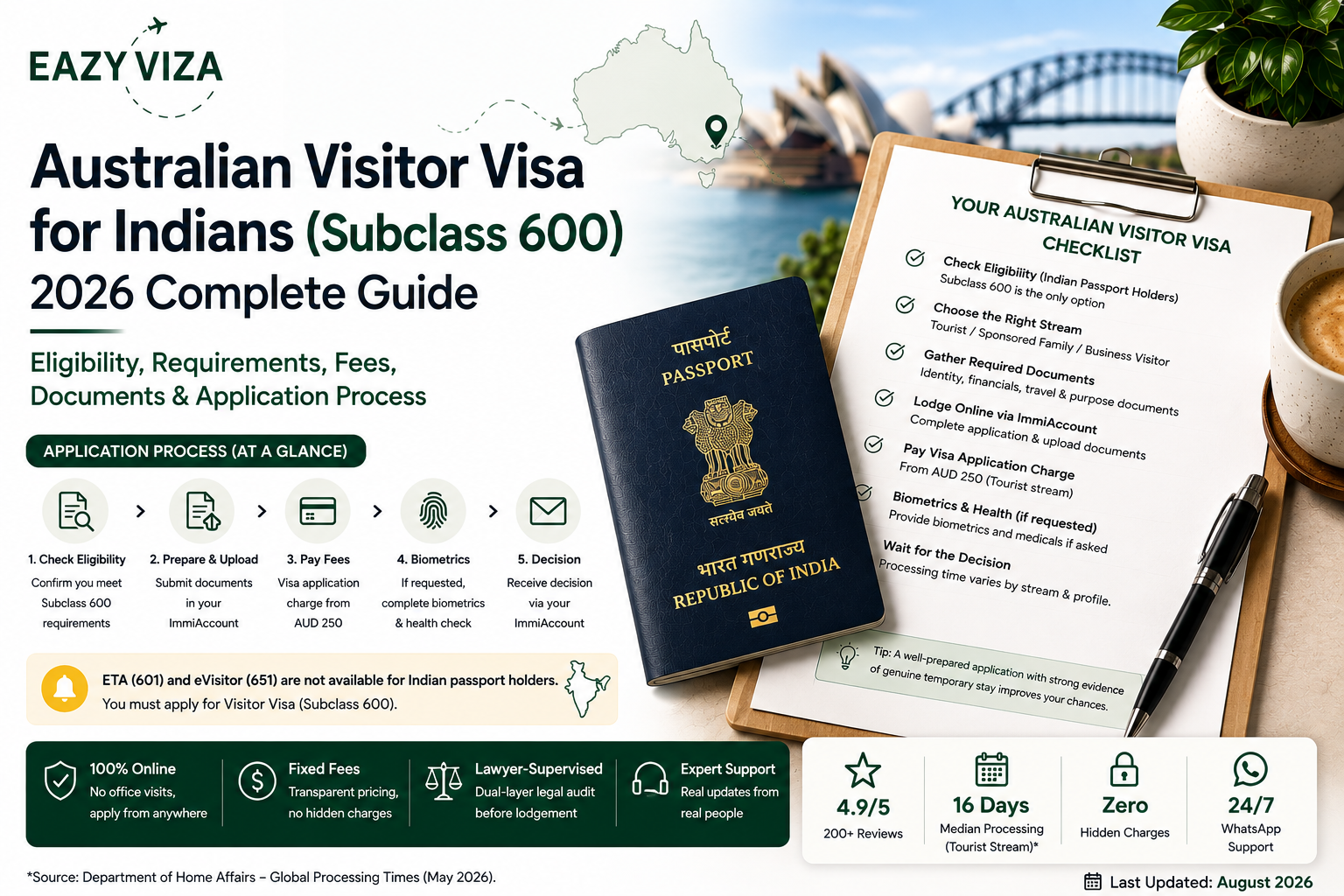
You apply for a Subclass 600 visa online through ImmiAccount, the Department's application portal (Home Affairs, Create your ImmiAccount). The process runs in a fixed order, and skipping ahead usually just means Home Affairs contacts you later for what's missing.
- Create your ImmiAccount. Register with an email address and set up your account before you start the form (Home Affairs).
- Start a new application and choose the correct stream. Home Affairs shows a personalised step-by-step guide once you select your visa and stream, so the exact screens differ between Tourist, Sponsored Family and Business Visitor applications (Home Affairs, Applying online in ImmiAccount).
- Complete the application form. Answer each question and click Next through every section. The form won't let you skip a required field, but it won't tell you if your answer is weak, that's a separate problem from a technical one.
- Attach your supporting documents. You need to attach identity and supporting documents before you can pay and submit. Each file can be up to 5MB, and the number of attachments allowed ranges from 30 to 60 depending on the application type (Home Affairs, attaching documents in Immi Account).
- Pay the application charge. Your application isn't processed until payment clears, so this step is what actually starts your file moving (Home Affairs, Apply and manage your application).
- Track and respond in Immi Account. Agreeing to electronic communication when you apply is what lets Home Affairs reach you quickly if they need more information, and a slow response to these requests is one of the more avoidable causes of a delayed decision (Home Affairs, Applying online in Immi Account).
If you'd rather not manage ImmiAccount yourself, this is exactly the part of the process our Visitor Visa service takes off your plate: we prepare the form, check the document set against what your stream actually needs, and submit on your behalf.
What happens after you submit. If your application or your country is part of the Department's Biometric Collection Program, you'll get a biometrics request letter shortly after lodgement and need to attend an Australian Biometric Collection Centre in person to provide fingerprints and a facial image (Home Affairs, Biometrics). Not every applicant is asked for this, and whether it applies to you depends on your specific country and visa combination, so treat the request letter, not a general assumption, as the confirmation. From there, Home Affairs may also contact you through Immi Account for extra documents before making a decision.
How Long Can You Stay? Validity and Multiple-Entry Options
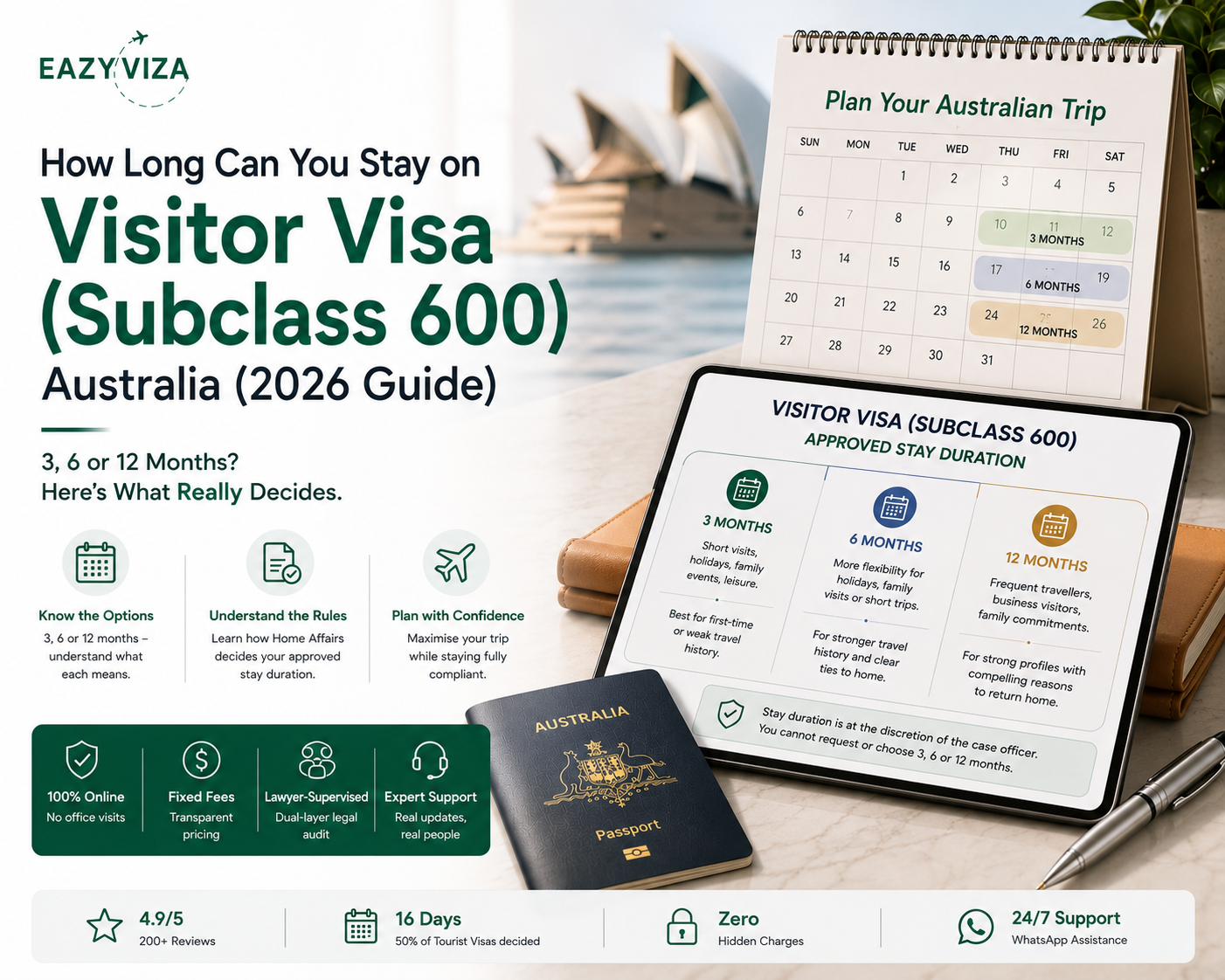
Most Subclass 600 grants allow a stay of 3, 6 or 12 months per entry, and Home Affairs decides the length and whether the visa is single or multiple-entry based on your circumstances and travel history (Home Affairs, Visitor visa 600). Repeat applicants with a clean travel history are generally better placed for a longer or multiple-entry grant than first-time applicants, though this is decided case by case, not guaranteed. For eligible frequent travellers, the Frequent Traveller stream can be granted for up to 10 years, but eligibility is limited to citizens of China, Brunei, Cambodia, the Philippines, Laos, Indonesia, Malaysia, Singapore, Thailand, Vietnam and Timor-Leste (Home Affairs, Frequent Traveller stream). If you want to stay longer after arriving in Australia, you'll typically need to apply for a new substantive visa before your current one expires, since a visitor visa doesn't extend automatically.
Multiple-entry grants aren't something you request on the form so much as something Home Affairs decides based on your file. A clean prior travel history to Australia, a clear reason for repeat visits (an ageing parent, a business relationship that needs regular in-person contact), and consistent financial evidence across each trip all weigh in favour of a longer, multiple-entry grant over a single-entry one. First-time applicants with no Australian travel history typically start with a shorter, more conservative grant, and build toward a longer one on their next application rather than their first.
Applying from India, the Philippines, or Sri Lanka: What's Different
Applicants from India commonly use the Sponsored Family stream to visit relatives, and the most frequent document gap is incomplete or inconsistent financial evidence between the applicant and the sponsor. Neither eVisitor nor the Frequent Traveller stream is available to Indian passport holders, so Subclass 600 with full supporting evidence is the only path. Home Affairs publishes stream and country-specific processing percentiles for India, updated monthly, on its live global visa processing times tool. Those figures move often enough, and the tool itself restricts automated access, that this guide won't quote a specific day count. Check the tool directly before you plan around a number (Home Affairs, Global visa processing times).
Applicants from the Philippines have an option Indian and Sri Lankan applicants don't: the Frequent Traveller stream, open to Filipino citizens who travel to Australia often for tourism or business, with grants of up to 10 years (Home Affairs, Frequent Traveller stream). If you travel to Australia more than once every year or two, it's worth checking this stream before defaulting to a standard Tourist stream application each time.
Applicants from Sri Lanka face a similar profile to Indian applicants: no eVisitor access and no Frequent Traveller eligibility, but with less English-language guidance available online than for the Indian corridor. In our own casework, the most common stall point for Sri Lankan Sponsored Family applications is proof of income for applicants in informal or cash-based employment, which needs more structured documentation than a standard payslip to satisfy Home Affairs.
Common Reasons Visitor Visa Applications Are Refused
Home Affairs doesn't publish a single refusal rate across all Subclass 600 applications, so treat any specific percentage you see quoted elsewhere with caution. What does show up repeatedly in refusal decisions is weak evidence of ties to the home country (no clear job, property, or family reason to return), inconsistent financial evidence between what the applicant and sponsor claim, an incomplete Sponsored Family sponsorship application, and a travel or visa history that raises doubts about genuine temporary entry. None of these are fixed technicalities. A case officer is weighing whether the file, taken as a whole, reads as consistent and complete, and a single missing document rarely sinks an application on its own the way an inconsistency between two documents does.
The most practical way to preempt a refusal is to read your own application the way a case officer would before you submit it. If your bank statement shows a different amount than what your sponsor claims to be providing, or your stated travel dates don't match your accommodation booking, that's the kind of gap a case officer flags before they even get to the substance of your case. Fixing these inconsistencies before lodgement is faster and cheaper than responding to a request for more information after the fact, and far faster than reapplying after a refusal.
How EazyViza Supports Your Visitor Visa Application
EazyViza's Visitor Visa (Subclass 600) service is lawyer-supervised and fixed price, so you know the cost before you commit, with file preparation starting within 24 to 48 hours of payment. That preparation covers matching you to the right stream, building the document set against what your specific stream needs (not a generic checklist), and completing the Immi Account lodgement itself. You can ask questions first over WhatsApp before you pay, and your case manager stays reachable on WhatsApp throughout. If you're not sure which stream fits your situation, our free eligibility checker takes about two minutes. If you want to see the full cost picture, government charges included, our cost calculator lays it out alongside our service fee.
Last reviewed: 31 July 2026. This article is general information only, not legal advice. Verify current requirements directly with the Department of Home Affairs or a qualified professional before you apply.
Frequently asked questions
What is the Australian Visitor visa (subclass 600)?
It's a temporary visa that lets you travel to Australia for tourism, to visit family, or for short business activities, for a period of 3, 6 or 12 months depending on the stream and your circumstances. It doesn't permit work in Australia.
Who is eligible for a visitor visa 600 from India?
Applicants from India, whatever the purpose, tourism, family visits or short business trips, apply through Subclass 600, since India isn't on the eVisitor eligible-country list and doesn't currently have Frequent Traveller stream access. Eligibility depends on the specific stream's requirements, funds, and ties to India.
What documents do I need for a visitor visa 600 application from India?
A valid passport, evidence of sufficient funds, and evidence of ties to India such as employment, property or family. Sponsored Family applicants also need a completed sponsorship application from their Australian sponsor and, in some cases, evidence covering a possible security bond.
How do I actually apply for a visitor visa 600?
You apply online through ImmiAccount: create an account, start the application for your chosen stream, complete the form, attach your supporting documents, then pay the application charge, which is what triggers processing to begin.
Can I extend my visitor visa after arriving in Australia?
There's no automatic extension. If you want to stay longer, you generally need to apply for a new substantive visa before your current visa expires, and approval isn't guaranteed.
What is the current visitor visa 600 application fee?
Government charges vary by stream and change periodically, so check the current fee directly on the Department of Home Affairs pricing page or use our cost calculator, which shows government and service fees together, rather than relying on a fixed number from an article.
How long does a visitor visa 600 application take to process from India?
Processing time depends on the stream, the completeness of your application, and current volumes. Home Affairs publishes country and stream-specific percentiles on its global visa processing times tool, updated monthly, which is the most reliable current figure.
Can a visitor visa convert into a work visa?
No. A visitor visa carries condition 8101, which prohibits work in Australia entirely. It doesn't convert into a work visa, and undertaking paid work while holding one can affect your current and future visa applications.
What is the difference between eVisitor (651) and visitor visa (600)?
eVisitor (651) is a free visa limited to eligible mostly-European passport holders. Subclass 600 carries an application charge but is open to any nationality, including India, the Philippines and Sri Lanka, and covers the Tourist, Sponsored Family and Business Visitor streams.
Do I need to give biometrics for a visitor visa?
It depends on your country and visa combination, not every applicant is asked. If you're part of the Department's Biometric Collection Program, you'll get a request letter shortly after you lodge, and you'll need to visit an Australian Biometric Collection Centre in person to provide fingerprints and a facial image. Treat the request letter, not a general assumption, as your confirmation either way.