When you apply for an Australian Visitor Visa (Subclass 600), you do not get to choose whether your visa comes back as single or multiple entry. You do not tick a box, select a duration, or request a specific number of entries. The case officer reading your file makes that call based on your travel history, your ties to your home country, and the picture your file paints. Understanding how that decision works, and what condition 8558 actually means once you have a multiple-entry grant, is what this guide is for. For the full stream overview, fees, and eligibility by nationality, see our Australian Visitor Visa (Subclass 600) 2026 guide.
Quick answer: A multiple-entry Subclass 600 Tourist visa lets you leave and re-enter Australia multiple times during its validity. Each visit is capped at the length stated on your grant notice (commonly 3 months, sometimes 6 or 12). If your grant carries condition 8558, you cannot spend more than 12 months in Australia within any rolling 18-month period, regardless of how many trips that involves. Leaving Australia does not reset that 18-month clock.
Single Entry vs Multiple Entry Visitor Visa Australia: Key Differences
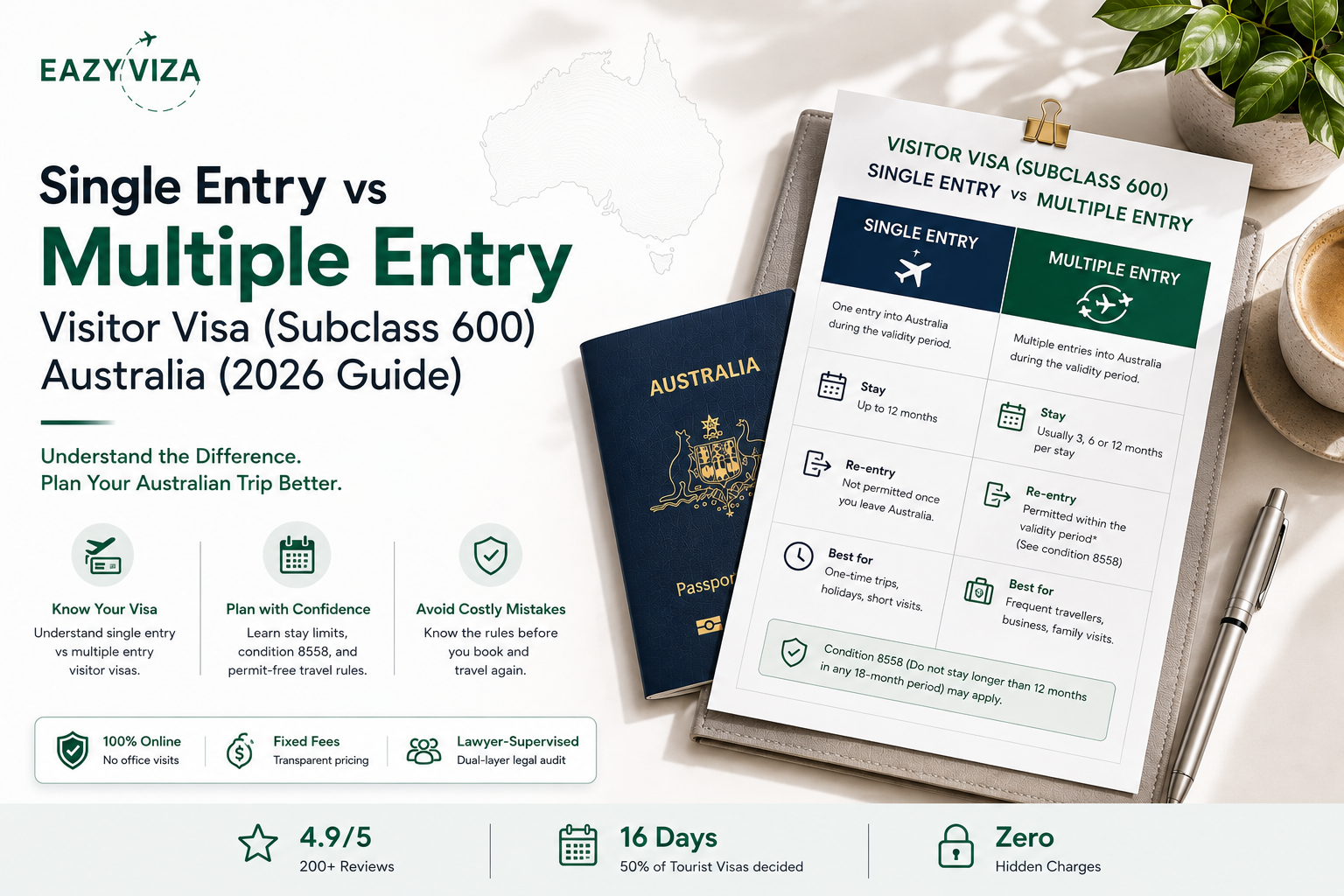
A single-entry Subclass 600 grant is exactly what it sounds like. You enter Australia once, stay for the period on your grant notice, and the visa is spent when you depart. If you want to come back, you must apply again from scratch.
A multiple-entry grant means the visa stays active after you leave. You can re-enter as many times as you like during the visa's validity window, as long as each stay does not exceed the permitted length on your grant notice and, if condition 8558 applies, your rolling 12-month accumulation stays within the allowed maximum.
Your grant notice is the only document that tells you which one you received. Check the "Travel" line: it will read either "Single entry" or "Multiple entries." Check the "Length of stay" line: that is the maximum for each individual visit, not the total. And check the conditions list for 8558: if it appears, the rolling accumulation rule applies to every trip you make on this visa.
| What your grant notice shows | What it means in practice |
|---|---|
| Travel: Single entry | One visit, then the visa is spent. Re-entry requires a new application. |
| Travel: Multiple entries | Leave and re-enter freely during validity. Each visit is capped at the stated length. |
| Length of stay: 3 months | Each individual visit may not exceed 3 months, regardless of how many you make. |
| Condition 8558 | Maximum 12 months in Australia within any rolling 18-month period. Leaving does not reset this. |
| Must not arrive after: [date] | The visa expires on this date. You cannot enter Australia after it, even if a prior stay had remaining time. |
Source: Home Affairs, Visitor Visa (Subclass 600); confirmed against real Subclass 600 grant notices for Indian and Bangladeshi Tourist stream applicants (December 2025 and May 2025 respectively).
What Decides Whether You Get Multiple Entry
Need expert guidance?
Speak with a migration specialist
Get personalised advice on your visa pathway — response within 2 hours.
Nothing in your ImmiAccount application form lets you select multiple entry. The case officer makes that decision based on the totality of your file. First-time applicants with no Australian travel history and limited international travel overall are more likely to receive shorter, single-entry grants. Repeat visitors with a clean compliance record and documented strong ties to their home country are better positioned for longer, multiple-entry grants. This is not a guarantee in either direction. It is a probability shaped by your profile, and the picture your documents paint.
Condition 8558 Explained: The 12-Month Rule for Australia Visitor Visas
Condition 8558 reads: "The holder must not be in Australia for more than 12 months in total in any period of 18 months." It is the condition that turns a multiple-entry grant from unrestricted access into a managed travel budget.
The 18-month period is rolling and backward-looking. Every time you arrive in Australia, Border Force calculates how many days you have spent in the country over the previous 18 months. If adding your planned stay would push that total past 12 months, you can be refused entry, even with a valid, current multiple-entry visa in your passport.
Critically, leaving Australia does not reset the clock. Departing on a Monday and returning on a Wednesday adds those two days back to your total. The 18 months rolls forward continuously from your first arrival, not from your most recent departure.
Use the Visa Entitlement Verification Online (VEVO) tool before booking each return trip. It shows your current conditions and can help you track your accumulation manually. Home Affairs does not send you a running total; the responsibility to stay within condition 8558 is entirely yours.
The Standard Tourist Stream: The Realistic Path for India and the Philippines
For applicants from India, the Philippines, and most other nationalities, the standard Tourist stream of the Subclass 600 visa (base fee: AUD 250 offshore) is the primary and most practical path to multiple-entry travel. The case officer decides whether your grant comes back as single or multiple entry based on your profile, as described above.
India has been part of a bilateral multiple-entry trial since 2016, which continues into 2026. Applicants from India with a consistent travel record, clean compliance history, and strong ties-to-home evidence are well-positioned to receive 3-year multiple-entry grants under the standard Tourist stream. The Komal Gir grant notice (Tourist stream, Indian passport, December 2025) confirms exactly this: a 3-year validity, multiple entries, 3 months per visit, and conditions 8558, 8101, and 8201.
For the Philippines, the same Tourist stream logic applies. A well-prepared application from a Filipino national with established travel history can result in a multiple-entry grant. Whether to use the Tourist stream or the Frequent Traveller stream instead depends on how often you plan to travel and whether the fee difference makes sense for your situation.
Unsure whether your profile is positioned for a 3-year multiple-entry grant? Our free eligibility checker takes two minutes and evaluates your current standing, including ties-to-home evidence and travel history, before you lodge.
The Frequent Traveller Stream: Who It Is Actually For
The Frequent Traveller stream is a separate Subclass 600 stream with a 10-year validity and multiple entries, each visit capped at 3 months. The application fee is AUD 1,845, compared to AUD 250 for the standard Tourist stream offshore. Condition 8558 still applies, so the 12-months-in-18-months accumulation rule does not go away even at 10-year validity.
This stream is available to citizens of 11 countries: China, Brunei, Cambodia, Philippines, Laos, Indonesia, Malaysia, Singapore, Thailand, Vietnam, and Timor Leste. In practice, it was originally designed as a China-specific initiative (announced by the Australian government in 2015 specifically for Chinese travellers) and remains primarily used by Chinese passport holders and high-frequency business travellers for whom the AUD 1,845 fee is justified by the convenience of a decade of access. Source: DFAT, Multiple-entry tourist visas set to drive repeat visits from China. If your passport is from a European country or another ETA-eligible nationality, the free eVisitor (651) or low-cost ETA (601) already gives you automatic multiple-entry access at no comparable cost — see our eVisitor vs Subclass 600 guide for the eligibility breakdown.
| Feature | Tourist Stream | Frequent Traveller Stream |
|---|---|---|
| Who can apply | Any nationality | Citizens of 11 specific countries (China, Philippines, Indonesia, Malaysia, Singapore, Thailand, Vietnam, Brunei, Cambodia, Laos, Timor Leste) |
| Base fee (offshore, 2026) | AUD 250 | AUD 1,845 |
| Maximum validity | Case officer's discretion (commonly 1 to 3 years for multi-entry grants) | Up to 10 years |
| Stay per visit | 3, 6, or 12 months depending on grant | 3 months per entry only |
| Condition 8558 applies? | Yes, on multi-entry grants | Yes |
| Realistic for India? | Yes, primary pathway | Not eligible |
| Realistic for Philippines? | Yes, more cost-effective for most | Eligible, but AUD 1,845 only justifies itself for very frequent travellers |
Sources: Home Affairs, Frequent Traveller stream; Home Affairs, Visa Pricing Estimator.
What Happens at the Australian Border on Re-Entry
A valid, current multiple-entry visa does not guarantee entry on every return trip. When you arrive in Australia, a Border Force officer assesses whether you remain a genuine temporary visitor at that point in time. If your pattern of entries suggests you are using a visitor visa to effectively live in Australia, entry can be refused even with a valid visa.
A few things that can raise concern at re-entry: very short gaps between visits (a weekend departure and immediate return), a cumulative stay pattern that approaches the condition 8558 limit, no clear purpose for the current visit beyond "tourism," and carrying large amounts of personal belongings or goods that suggest an extended stay.
None of these are automatic refusal grounds, but each one gives an officer more reason to ask questions. Being able to clearly explain why you are returning, where you are staying, and when you plan to leave is practical preparation for any re-entry on a multiple-entry visa.
What Can Cancel a Multiple-Entry Visa
A single breach of your visa conditions can result in the entire visa being cancelled, not just the current visit. Working in Australia in breach of condition 8101, exceeding your permitted length of stay, or being found to have provided misleading information on your application can all trigger cancellation under Section 116 of the Migration Act 1958.
Once cancelled, you become an unlawful non-citizen immediately. A re-entry ban under PIC 4014 (up to 3 years) can follow. The cancellation record attaches permanently to your immigration history and is visible on every future Australian visa application you make. For what counts as work under condition 8101 and what does not, see our Condition 8101 guide. If your visa has already been cancelled, our ART Review Application service can assess whether a review is available.
How This All Connects to Your Next Application
If you hold a multiple-entry Subclass 600 Tourist visa and use it well, that clean compliance record becomes the strongest single factor working in your favour the next time you apply. Repeat visitors who arrive when they say they will, leave when they are supposed to, and stay within condition 8558 are precisely the profile that case officers associate with a genuine temporary entrant under clause 600.211 of the Migration Regulations 1994. A well-managed visa history can move you from a 3-month single-entry grant on your first application toward a 3-year multiple-entry grant on your second or third.
Whether you are preparing your first Subclass 600 application or planning travel on an existing multiple-entry grant, the details of your file and the way you track condition 8558 both matter. Our lawyer-supervised team can help you build the strongest possible application before you lodge, or help you understand your accumulation position before your next trip to Australia.
Last reviewed: 19 August 2026. Fees verified against the Home Affairs Visa Pricing Estimator. Condition 8558 confirmed against real Subclass 600 grant notices for Tourist stream applicants (December 2025 and May 2025). Always check VEVO before every entry to Australia and the live Home Affairs website for current requirements.
Frequently asked questions
Can I apply for a multiple-entry Australian visitor visa?
You cannot select multiple entry during your application. The case officer grants single or multiple entry based on your profile, primarily your previous Australian and international travel history, your ties to your home country, and the strength of your overall file. First-time applicants are more likely to receive single-entry grants. Repeat visitors with a clean compliance record are better positioned for multiple-entry grants.
How long is a multiple-entry Australian visitor visa valid for?
Validity is determined by the case officer, not the applicant. Tourist stream grants commonly range from a few months for first-time applicants to 3 years for applicants with established travel history. The Frequent Traveller stream (eligible for citizens of 11 specific countries and costing AUD 1,845) can grant up to 10 years. Your grant notice states the exact expiry date under "Must not arrive after."
What is condition 8558 on an Australian visa?
Condition 8558 reads: "The holder must not be in Australia for more than 12 months in total in any period of 18 months." It is commonly attached to multiple-entry Subclass 600 Tourist grants. The 18-month period is a rolling, backward-looking calculation. Every time you enter Australia, Border Force calculates how many days you have spent in Australia over the previous 18 months. Leaving Australia does not reset this clock.
Can Indian nationals get a 3-year multiple-entry visitor visa for Australia?
Yes. India is part of a bilateral multiple-entry arrangement with Australia that has been active since 2016. Indian applicants with a consistent travel history, strong ties-to-home evidence, and a well-prepared Tourist stream application are well-positioned to receive 3-year multiple-entry grants under the standard Subclass 600 Tourist stream (base fee: AUD 250 offshore). It is not guaranteed and remains at the case officer's discretion.
How many times can I enter Australia on a multiple-entry visitor visa?
There is no published limit on the number of entries during a multiple-entry visa's validity, provided each individual stay does not exceed the period stated on your grant notice and your total time in Australia does not exceed 12 months in any rolling 18-month period under condition 8558. Border Force can also refuse entry on any visit if they have reason to believe the visit is not genuinely temporary.
Can I be refused entry to Australia even with a valid multiple-entry visa?
Yes. A valid, current visa does not guarantee entry. On every arrival, a Border Force officer assesses whether you are a genuine temporary visitor. If your pattern of entries suggests you are using a visitor visa to effectively reside in Australia, entry can be refused under the Migration Act 1958. Very short gaps between visits, accumulation close to the condition 8558 limit, and unclear purpose for the current visit can all prompt additional questioning.
What happens to my multiple-entry visa if I overstay once?
An overstay is a breach of your visa conditions and can lead to cancellation of the entire visa under Section 116 of the Migration Act 1958, not just the current visit. Cancellation makes you an unlawful non-citizen immediately and can trigger a re-entry ban of up to 3 years under PIC 4014. The cancellation record attaches to your immigration history permanently.
What is the difference between the Tourist stream and the Frequent Traveller stream for multiple entry?
The Tourist stream (AUD 250 offshore, any nationality) can be granted as multiple entry at the case officer's discretion. The Frequent Traveller stream (AUD 1,845, citizens of 11 specific countries including China and the Philippines) grants up to 10 years validity with multiple entries, but each visit is capped at 3 months and condition 8558 still applies. For most Indian and Filipino applicants, the AUD 250 Tourist stream is the more cost-effective and practical path to multiple-entry travel.
Does leaving Australia reset the condition 8558 clock?
No. The 18-month period in condition 8558 is a rolling, backward-looking calculation from every new entry date. Departing Australia and returning shortly after does not reset the window. Border Force calculates your total days in Australia over the previous 18 months at each entry. Using VEVO before every trip to check your current conditions is the only way to track your accumulation position accurately.
Can I convert a single-entry visitor visa to a multiple-entry visa after it has been granted?
No. Once a Subclass 600 visa is granted, its conditions including the entry type cannot be changed or upgraded. If you received a single-entry grant and want multiple-entry access, you must lodge a new application from scratch. A stronger second application built on the clean compliance record from your first visit gives you a better chance of receiving a multiple-entry grant next time.