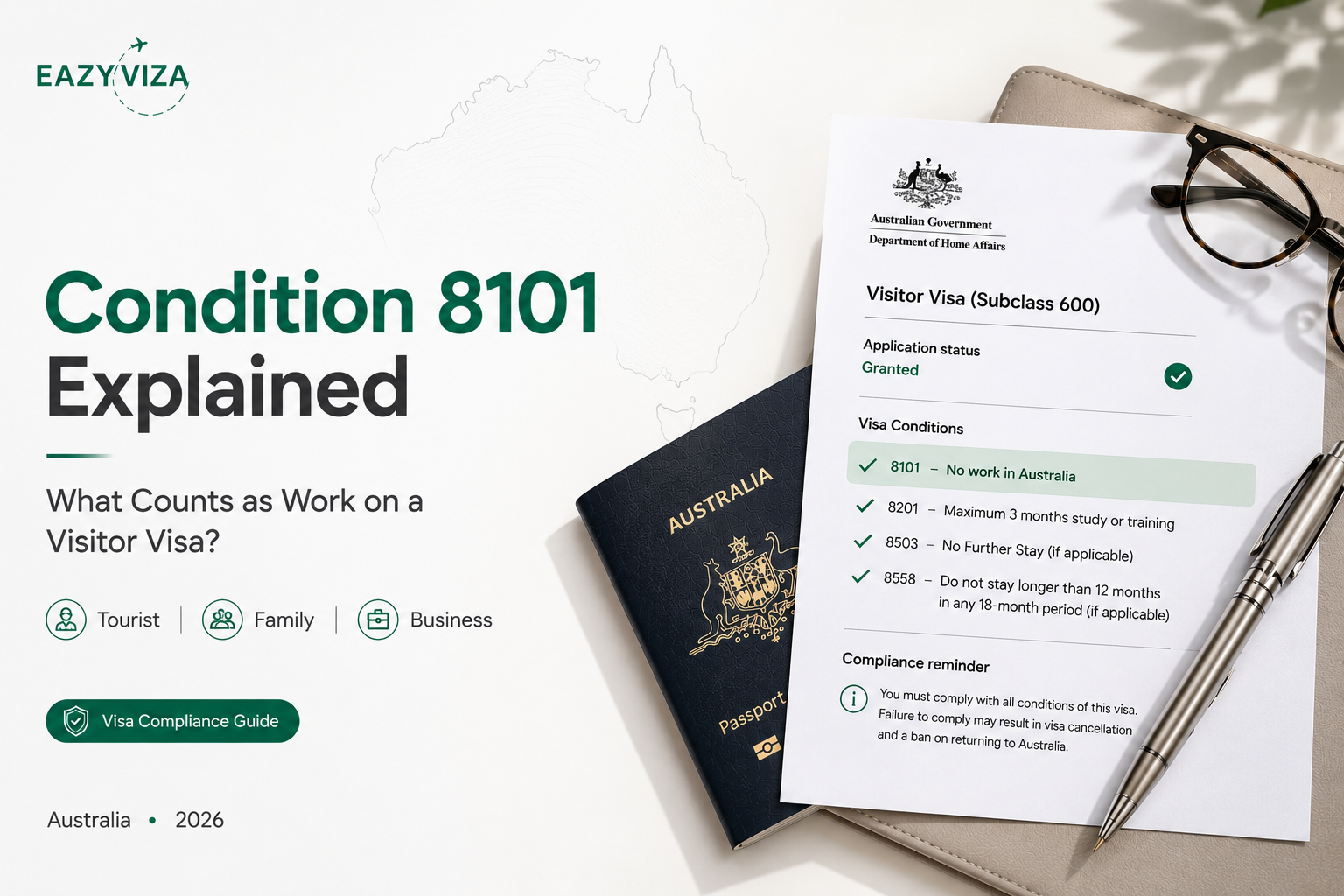
Condition 8101 is a mandatory visa condition under Schedule 8 of the Migration Regulations 1994, attached to all Australian Visitor visas (Subclass 600). Its full legislative text is seven words: "The holder must not engage in work in Australia." (Migration Regulations 1994, Schedule 8, AustLII.) Those seven words create more real-world confusion than almost any other visa condition, because what counts as "work" under Australian immigration law covers more ground than most applicants expect, and the line between a breach and a permitted activity is often driven by policy rather than the legislation itself.
This guide answers the questions that matter most: whether remote work for an overseas employer is a breach, whether helping a relative in their restaurant counts as work, and what actually happens if the condition is broken. For a full overview of the Subclass 600 Visitor Visa, its streams, and how to apply, see our Australian Visitor Visa (Subclass 600) 2026 guide.
Key Takeaways
- The exact legislative text is "The holder must not engage in work in Australia," confirmed at Schedule 8 of the Migration Regulations 1994.
- Condition 8101 is mandatory and non-discretionary on both the Tourist and Sponsored Family streams of the Subclass 600 Visitor Visa.
- Remote work for an overseas employer is generally tolerated under Home Affairs administrative policy if it is incidental to your trip, but this is policy guidance, not legislation, and it can change.
- Breach gives Home Affairs grounds to cancel your visa under Section 116 of the Migration Act 1958 and can trigger a re-entry ban of up to three years under PIC 4014.
Can I Work Remotely on an Australian Visitor Visa?
This is the question most people are actually searching for when they look up condition 8101. The answer is not a flat no, but it depends on three specific factors that most guides either skip or bury in legal language.
Home Affairs has documented an administrative policy position on online work. Performing remote tasks for a non-Australian employer, or continuing to operate your overseas business while visiting Australia, is generally not treated as a breach of condition 8101 if the work is incidental to your trip.
To remain within policy, your remote work must meet all three of the following criteria:
- Primary purpose: Your primary intent in visiting Australia must be tourism, a holiday, or visiting family. You must not be in Australia primarily in order to work remotely.
- Economic source: You must be paid by an entity outside Australia into a foreign bank account. You must not be supplying goods or services to Australian consumers or businesses.
- No local market impact: Your work must not compete with or replace a position that an Australian resident would otherwise fill.
One honest caveat before relying on this: it is administrative policy guidance, not legislation. It does not appear in the Migration Regulations themselves, is not binding on individual case officers, and can change without notice. If you plan to work remotely during your visit, especially an extended one, declare that intention clearly on your visa application. Source: Home Affairs, work rights and restrictions.
What Counts as Work Under Condition 8101
Need expert guidance?
Speak with a migration specialist
Get personalised advice on your visa pathway — response within 2 hours.
Quick Answer: Under Australian migration law, condition 8101 prohibits any activity that would normally attract payment in the Australian labour market. Remote work for a foreign employer is generally permitted under policy if you are paid into an overseas account and your primary intent remains tourism or visiting family.
Home Affairs applies a functional definition of "work": any activity that would normally attract remuneration in the Australian labour market. Whether you actually receive a payslip, bank transfer, or any other form of payment is less important than whether a resident would typically be paid to perform that task.
| Activity | Breach? | Notes |
|---|---|---|
| Paid employment for an Australian employer | Yes, clear breach | Prohibited under all circumstances. |
| Freelancing or contracting for Australian clients | Yes, clear breach | Direct participation in the local labour market. |
| Paid speaking engagement funded by an Australian entity | Yes, clear breach | Commercial activity attracting local payment. |
| Remote work for an overseas employer (incidental to trip) | Generally no | Tolerated under policy guidance. Declare on application. |
| Attending conferences, trade fairs, or negotiations | No | Business Visitor stream activity. Not employment. |
| Short-term unpaid family help | No | Permitted if not substituting for a paid commercial role. |
| Volunteering in a role that normally attracts pay | Grey area | The commercial nature of the function is what matters. |
Real-World Scenarios That Most Guides Don't Cover
Can I help in my brother's restaurant for a few hours on a busy night? This carries a real breach risk even if you receive no payment. Kitchen and front-of-house work in a commercial restaurant is precisely the type of role that attracts pay in Australia. The family relationship does not change the commercial nature of the activity.
Can I babysit my sister's children in exchange for free accommodation? Short-term, informal family help is generally fine. The problem arises when the arrangement becomes regular or ongoing, or when it substitutes for what would otherwise be a paid nanny, au pair, or childcare arrangement. The line is the commercial substitute nature of the role, not the accommodation arrangement itself.
What if I am paid in cryptocurrency by my overseas employer? The payment method is completely irrelevant. Home Affairs looks at the nature of the activity and whether it competes with the Australian labour market, not whether payment arrived in Australian dollars, cryptocurrency, or any other form. Crypto income from an overseas employer for work performed in Australia is still income.
What about being a social media influencer or content creator? Creating content for an overseas audience while in Australia, with income from overseas advertising or brand partnerships, generally falls within the incidental online work policy. Attending a paid promotional event in Australia, or receiving payment directly from an Australian brand, does not.
Source: Home Affairs, visa conditions list.
What Visitor Visa Holders Are Permitted to Do
Unpaid family support
Genuine short-term family help is permitted: caring for a newborn, accompanying a relative to appointments, helping with household tasks during a stay. The limit is when the support becomes ongoing, replaces a commercial service, or extends far beyond the natural scope of a family visit.
Genuine volunteer work
Volunteering for a registered charity or non-profit is generally acceptable when: the primary purpose of your visit remains tourism or visiting family, the role would not normally attract pay in the Australian labour market, and you receive no remuneration beyond reasonable out-of-pocket reimbursement or basic board and lodging.
Business Visitor stream activities
Attending conferences, trade fairs, and seminars; negotiating and signing contracts; conducting business enquiries; and official government-to-government visits are all permitted under the Business Visitor stream because they do not constitute employment (Home Affairs, Business Visitor stream). Receiving payment from an Australian entity for any of these activities tips into breach territory regardless of what the work is called.
What Happens If You Breach Condition 8101
Breach gives Home Affairs grounds to cancel your visa under Section 116 of the Migration Act 1958. Most cases start with a formal written notice before cancellation proceeds, but the process can move quickly in serious or clear-cut cases.
Notice of Intention to Consider Cancellation (NOICC): You receive a formal written notice detailing the suspected breach and a strict timeframe to submit a written response. This is your opportunity to provide evidence and context. Taking this notice seriously and responding thoroughly is the most important step at this stage.
Visa cancellation under Section 116: If your response is rejected, the visa is cancelled. You become an unlawful non-citizen immediately. If you are in Australia at the time, you must apply for a Bridging Visa E or face potential detention.
PIC 4014 re-entry ban: A visa cancellation for non-compliance can trigger a ban of up to three years on future Australian temporary visa applications under Public Interest Criterion 4014. This is a potential consequence, not an automatic one, but the cancellation record attaches to your immigration history permanently and is visible in every future visa application you make.
ART appeal rights: Onshore visa holders generally have the right to seek review of a cancellation decision through the Administrative Review Tribunal, subject to strict timeframes. Acting quickly after receiving a cancellation notice is critical, as missing the deadline removes the right to merits review entirely.
Planning a visit to Australia and unsure whether your planned activities comply?
Check your Subclass 600 options in two minutes with our free eligibility checker, or talk through your specific situation on WhatsApp before you apply.
How to Remove Condition 8101 from a Bridging Visa
Condition 8101 cannot be removed from a standard Subclass 600 Visitor Visa. It is mandatory and non-discretionary on both the Tourist and Sponsored Family streams and cannot be waived after the visa is granted.
The only pathway to removal is when condition 8101 is attached to a Bridging Visa C or Bridging Visa E. To apply, you must submit a formal request to the Department of Home Affairs demonstrating severe financial hardship, with supporting documentation showing all of the following:
- Inability to meet basic living costs including food, shelter, and essential medical care.
- Bank statements confirming zero or negligible accessible funds.
- Evidence of no available financial support from family, sponsors, or foreign income sources.
The hardship standard is applied strictly. The threshold is genuine inability to afford basic necessities, not simply having limited funds.
On a Bridging Visa and facing financial hardship?
Our lawyer-supervised team can assess whether you qualify to have condition 8101 removed and work rights added to your Bridging Visa, and help you prepare the supporting documentation to meet Home Affairs' hardship standard.
Source: Home Affairs, Apply and manage your application.
Condition 8101 vs Other Visa Work Conditions
Understanding how condition 8101 differs from related conditions helps prevent accidental non-compliance if your visa category changes during your stay in Australia.
| Condition | Rule | Typical Visa |
|---|---|---|
| 8101 | No work at all. Complete prohibition on commercial work and local employment. | Visitor 600, eVisitor 651, Bridging C/E |
| 8102 | No work except activities required as part of a course of study or training. | Some student-adjacent and training visas |
| 8104 | Work permitted up to 48 hours per fortnight while course is in session. | Dependants of Student Visa (Subclass 500) holders |
| 8105 | Work limited to 48 hours per fortnight during study terms; unrestricted during course breaks. | Primary Student Visa (Subclass 500) holders |
For a full breakdown of how student visa work rights changed from 1 July 2026, including the 48-hour fortnight rule and condition 8105, see our Australian Visa Changes 1 July 2026 guide. Source: Migration Regulations 1994, Schedule 8, AustLII.
Where to Go From Here
If you've read this far, you already understand condition 8101 better than most applicants who apply for a visitor visa each year. That matters, because the people who run into trouble aren't usually trying to do something wrong. They're people who helped out at a family business for a weekend, or kept their laptop open for their overseas job without realising the grey area, or assumed a personal invitation letter was enough to sponsor a family member. You're not that person now.
What we do at EazyViza is straightforward: a certified agent prepares your file, a lawyer reviews it before it's submitted, and you pay one fixed price from the start with no surprises. No hourly billing, no chasing people for updates, no guessing whether your application is actually compliant. If your situation has any complexity at all, whether that's a previous refusal, a long stay, or remote work you want to declare properly, that's exactly what our team handles every day.
Two free tools to start with, no account needed:
Last reviewed: 5 August 2026. This article is general information only, not legal advice. Verify current requirements directly with the Department of Home Affairs or a qualified migration professional before you act on anything in this guide.
Frequently asked questions
What does condition 8101 means on a visa?
Condition 8101 is a mandatory Australian visa restriction meaning no work. It prohibits paid employment, freelance contracting, and performing commercial services for Australian businesses or residents while physically in Australia. It appears on Visitor visas (Subclass 600), eVisitor (651), ETA (601), and some Bridging Visas.
Can I do remote work on an Australian visitor visa?
Remote work for an overseas employer is generally tolerated under Home Affairs administrative policy if it is incidental to your main travel purpose, paid into an offshore bank account, and does not service the Australian market or compete with the local labour market. This is policy guidance, not legislation. Declare your intentions on your application and seek advice for stays beyond a few weeks.
What happens if I breach condition 8101?
Breach gives Home Affairs grounds to cancel your visa under Section 116 of the Migration Act 1958. You will usually receive a Notice of Intention to Consider Cancellation first, with a right to respond. Cancellation makes you an unlawful non-citizen immediately and can trigger a re-entry ban of up to three years under PIC 4014, as well as an adverse immigration record affecting every future Australian visa application.
How do I remove condition 8101 from my visa?
Condition 8101 cannot be removed from a Subclass 600 Visitor Visa. If it is attached to a Bridging Visa C or E, you may apply to Home Affairs to have it removed by demonstrating severe financial hardship, supported by bank statements and evidence of an inability to meet basic living costs including food, shelter, and essential medical care.
Is condition 8101 mandatory for all Subclass 600 visitor visa holders?
Yes. It is a mandatory, non-discretionary condition on both the Tourist and Sponsored Family streams of the Subclass 600 Visitor Visa. It also commonly appears on Bridging Visas C and E, where removal is possible only through a separate formal application on financial hardship grounds.