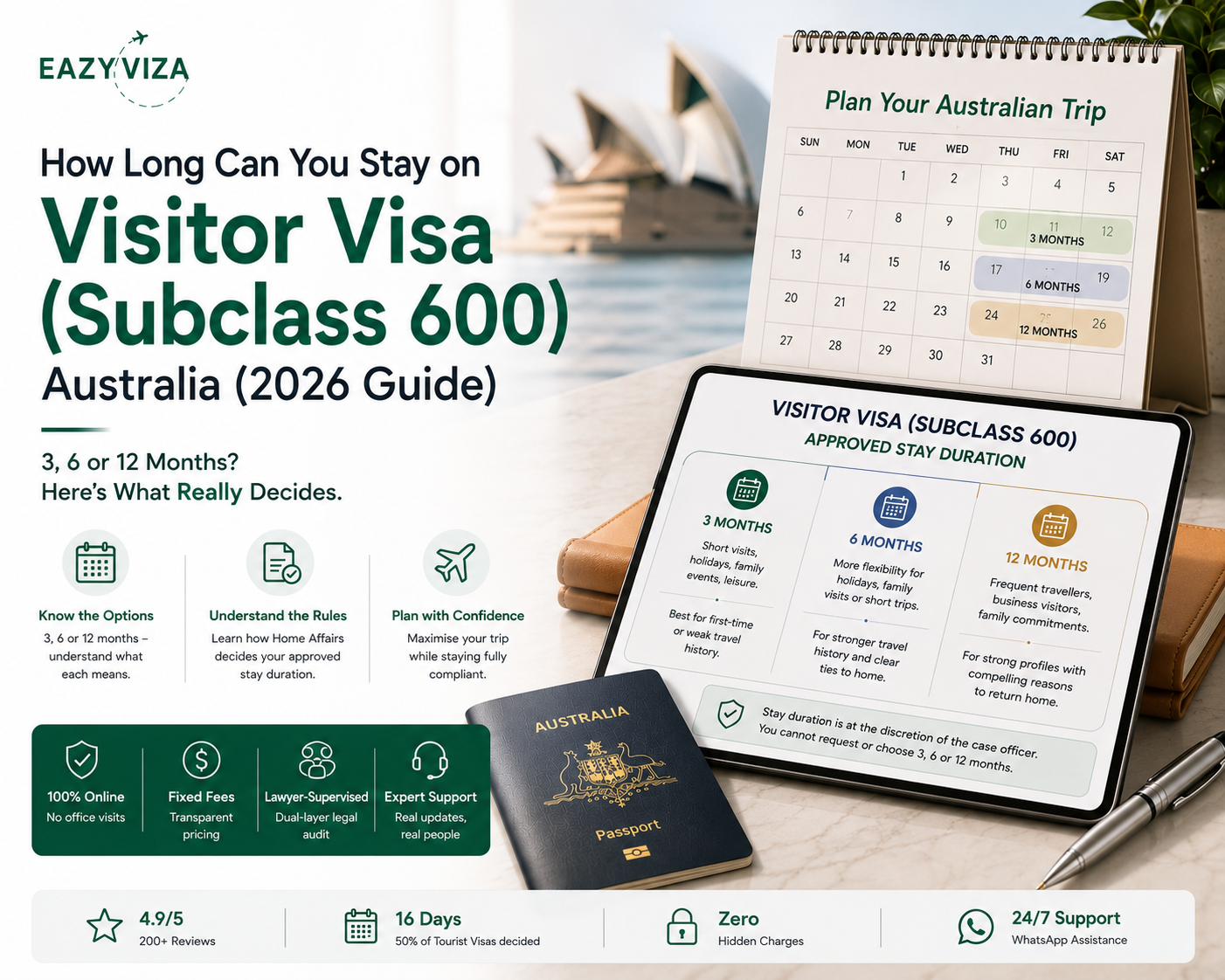
A common question before lodging a Subclass 600 Tourist visa application is whether you can choose to be granted 3, 6, or 12 months. The short answer is no, not directly. The Australian tourist visa duration is not a dropdown menu or a selection you make. When you complete your application in ImmiAccount, there is a field where you enter your intended travel dates and indicate the longest period you plan to stay on any single visit. That information, combined with everything else in your file, is what the case officer uses to assess an appropriate length of stay under clause 600.211 of the Migration Regulations 1994. They decide. Your documents either support the duration your trip genuinely needs, or they do not. Understanding that distinction is what this guide is for. For the full Subclass 600 overview, fees, and streams, see our Australian Visitor Visa (Subclass 600) 2026 guide. For our lawyer-supervised application service, see our Visitor Visa service page.
Quick answer: There is no menu where you select 3, 6, or 12 months. You enter your intended travel dates and your trip purpose. The case officer grants a tourist visa Australia duration based on what your documents support under clause 600.211 of the Migration Regulations 1994, which requires genuine visitor intent to stay temporarily in Australia. Most first-time applicants from India, the Philippines, Sri Lanka, and Bangladesh receive 3-month grants. Six months requires a specific, well-evidenced extended purpose. Twelve months is exceptional and tied to defined circumstances only.
How the Australian Tourist Visa Duration Is Actually Decided
When you lodge a Subclass 600 Tourist visa application, the ImmiAccount form asks for your intended travel dates and the longest single stay period you are planning. That is not the same as choosing a duration. It is your stated intention, and it is one of the inputs the case officer uses when assessing your file. They look at your stated dates alongside your leave approval, your financial evidence, your ties to your home country, and the specific purpose you have given for the trip. All of those elements together build the picture under clause 600.211 of the Migration Regulations 1994.
Real grant notices confirm how the standard outcome looks in practice. An Indian national (Tourist stream, December 2025) received "3 month(s) from the date of each arrival" on a 3-year multiple-entry grant. A Bangladeshi national (Tourist stream, May 2025) received the same. A Filipino national (Tourist stream, September 2023) received 1 month on a single-entry grant. None of these applicants selected a duration. It was assessed.
Source: Home Affairs, Visitor Visa (600) Tourist stream (applied outside Australia); Migration Regulations 1994, clause 600.211 (Federal Register of Legislation).
What Each Tourist Visa Australia Duration Actually Represents
Need expert guidance?
Speak with a migration specialist
Get personalised advice on your visa pathway — response within 2 hours.
The three possible lengths of stay granted on a Subclass 600 Tourist visa correspond to three different applicant profiles and three different evidence requirements. Knowing which profile you genuinely fit is more useful than hoping for a longer outcome.
| Length of stay granted | Typical applicant profile | What the file must show | Most common in EazyViza markets |
|---|---|---|---|
| 3 months | First-time or early-repeat visitors with a specific holiday, tourism, or casual family visit purpose | Consistent dates across itinerary, leave letter, and financial evidence. Clear return intention with specific departure date. Standard ties-to-home evidence. No unexplained gaps between documents. | The default outcome for most Indian, Filipino, Sri Lankan, and Bangladeshi applicants. The grant gives you up to 3 months from each arrival date, which is often more than the actual trip requires. |
| 6 months | Applicants with a specific extended purpose that genuinely takes longer than 3 months and is clearly documented across every element of the file | Leave letter or pension certificate covering the full 5 to 6 month period. Financial evidence demonstrating ability to fund the full duration. Specific purpose with named dates, events, or family circumstances. A credible return signal showing what the applicant is going back to after an extended absence. | Grandparent visiting a newborn grandchild for several months. Parent attending a graduation followed by extended family travel. Visitor covering multiple Australian states with a substantive itinerary that genuinely takes 5 to 6 months to complete. |
| 12 months | Exceptional circumstances only. Home Affairs applies a critical assessment under clause 600.211 for these grants and they are not routinely issued. | Parent of an Australian citizen or permanent resident, particularly those already in the formal parent visa queue and assessed as low-risk. Or a critical need to support a close family member who is seriously ill, seriously injured, or recently deceased. Strong compliance history essential. All standard evidence at the highest quality. | Rare across all markets. Not available simply by asking for it or by stating a preference for a longer stay. Each case is individually assessed against the specific circumstances. |
Source: Home Affairs, Visitor Visa (Subclass 600); Migration Regulations 1994, clause 600.211 (Federal Register of Legislation).
The Consistency Test: The Single Check That Predicts Your Visitor Visa Length of Stay
Before you lodge, run every document in your file through one question: do all of these cover exactly the same period? Your leave approval dates, your itinerary start and end dates, your financial evidence covering the trip, and your stated purpose all need to tell the same story. A case officer reads a file as a single narrative under clause 600.211. The moment one document implies a different timeline to the others, the narrative breaks, and the length of stay granted reflects the shortest period your evidence actually supports, not the longest period you want.
For the complete stream-by-stream document checklist, including what constitutes strong financial evidence and what a well-structured leave letter must contain, see our Visitor Visa Document Checklist 2026.
The Asking-for-More Trap: Why Requesting 12 Months Can Hurt Your Application
A widely held belief among first-time applicants is that stating a longer intended stay increases your chances of receiving a longer grant. It does not. If your employer leave letter covers three weeks and your ImmiAccount entry implies six months, the case officer sees an inconsistency, not an ambition. That inconsistency is exactly the kind of signal that triggers closer scrutiny under clause 600.211 of the Migration Regulations 1994, which requires genuine visitor intent to stay temporarily in Australia. A stated six-month trip with a three-week leave approval is not internally consistent, and internal consistency is what the assessment is designed to check.
Your intended stay dates should match your leave approval exactly. If your employer has approved 21 days and your itinerary reflects 21 days, your application is consistent under clause 600.211. If your itinerary reflects 6 months and your leave approval covers 21 days, the case officer must decide which document to believe about when you are actually returning home.
Requesting a longer Australian tourist visa duration than your documents support does not increase your chances of a longer grant. It introduces a credibility gap. Resolve that gap before you lodge by either securing the appropriate leave coverage for the duration you genuinely need, or aligning your stated dates to what your leave actually permits.
Real Scenarios: What Realistic Visitor Visa Australia Duration Outcomes Look Like
"I am visiting Australia for the first time from India for a 3-week trip."
This is the most common profile across EazyViza's markets. First-time applicant, specific tourism or family visit purpose, leave letter covers the trip, financial evidence is consistent, ties-to-home evidence is clear. A 3-month grant on an Australian tourist visa is the standard outcome and it is appropriate here. The grant gives you a full 3 months from your arrival date, considerably more than the 3-week trip requires, and any unused time is simply not used.
"My parents want to come to Australia after the birth of my baby to help for 4-5 months."
A 6-month Australian visitor visa is genuinely appropriate here if the file supports it. Your parents need a retirement certificate or pension statement covering the full period (since there is no employer leave letter), financial evidence demonstrating they can fund 5 months in Australia, and a specific purpose statement tied to the birth with named dates. If you are formally sponsoring them under the Sponsored Family stream, the sponsorship paperwork must also be in order. See our Invitation Letter and Form 1149 guide for the exact format that documentation needs to take.
"My parents are Australian permanent residents and are already in the parent visa queue waiting for their permanent visa."
Home Affairs assesses 12-month grants under specific documented circumstances. A parent in the formal parent visa queue who is assessed as low-risk is one of them. This is not a routine outcome. It requires a file demonstrating strong compliance history, no overstay risk, clear documentation of the parent visa queue position, and all standard evidence at the highest quality. It is assessed critically against genuine visitor intent under clause 600.211 of the Migration Regulations 1994.
"I want to see all of Australia so I put 12 months as my intended stay. My leave approval covers 2 weeks."
A vague tourism purpose, a 2-week leave approval, and a stated 12-month intended stay are not internally consistent. The case officer assessing genuine visitor intent under clause 600.211 reads the leave approval, not the intended stay entry, as the binding evidence of when you are actually going home. The grant reflects what your documents support. Resolving this before lodging means matching your stated dates to your actual leave, not overstating a duration your file cannot justify.
Can I Extend My Visitor Visa Length of Stay Once I Am in Australia?
You cannot extend the length of stay on an existing Subclass 600 Tourist visa once it has been granted. The granted period is the decision. If you are already in Australia and your permitted stay is coming to an end, you need to either depart before the expiry or lodge a new substantive visa application from within Australia, provided Condition 8503 (No Further Stay) has not been attached to your current grant. If Condition 8503 is present on your grant notice, you cannot apply for most other visas while in Australia and must depart.
If you need to come back to Australia after complying with your current grant, a new Subclass 600 Tourist application from outside Australia is the correct path. A clean compliance record on this grant, departing before your permitted stay ends, is the single most useful contribution you can make to your next application. For how multiple trips and the rolling 18-month accumulation work under condition 8558, see our Multiple-Entry Visitor Visa guide.
If Your Grant Is Shorter Than You Needed
The length of stay on a granted Subclass 600 visa is not appealable. The ART review process exists for outright refusals, not for cases where a shorter duration than hoped was granted. It is also important to know that offshore Tourist stream applicants without an eligible Australian sponsor generally have no ART review rights even on a full refusal, which makes a well-prepared initial application the most important safeguard available. Source: Home Affairs, Tourist stream (applied outside Australia).
If you received a shorter grant than your circumstances genuinely justified, the practical path is to comply fully with the current grant, depart on time, and apply again from outside Australia with a more completely documented file. The compliance record you build on this grant is what moves you toward a longer grant next time. For re-applications or formal reviews after a full refusal, our ART Review Application service can assess whether a review is available and appropriate.
Match your stated travel dates to your leave approval before you open the form. State a specific trip purpose with named events, family circumstances, or locations where relevant. Make sure your financial evidence covers the full period your dates imply. Run the four-document consistency test above before attaching anything. A file that holds together tells a credible story under clause 600.211. That is what produces an appropriate Australian tourist visa length of stay.
If your situation genuinely requires a longer tourist visa Australia duration and you are not sure whether your file is strong enough to support it, our lawyer-supervised team checks your documents before you lodge. We look for the consistency gaps that most often result in a shorter grant than the circumstances justify, and we prepare the complete application with fixed pricing and file start within 24 to 48 hours.
Last reviewed: 21 August 2026. Verified against Migration Regulations 1994 (clause 600.211), Home Affairs Visitor Visa (Subclass 600) Tourist stream page, and real grant notices for Indian, Bangladeshi, and Filipino Tourist stream applicants (December 2025, May 2025, September 2023). Always check the live Home Affairs website before lodging as policy and practice can change.
Frequently asked questions
Can I choose how long my Australian visitor visa is for?
No. There is no dropdown in ImmiAccount where you select 3, 6, or 12 months. The form asks for your intended travel dates and the longest single stay you plan. The case officer grants a length of stay based on what your documents and circumstances support under clause 600.211 of the Migration Regulations 1994, which requires genuine visitor intent to stay temporarily in Australia. Most first-time applicants from India, the Philippines, Sri Lanka, and Bangladesh receive 3-month grants.
How do I get a 6-month Australian visitor visa instead of 3 months?
A 6-month grant requires a specific, well-documented purpose that genuinely takes longer than 3 months, with every document covering the same extended period. A parent visiting a newborn grandchild for 5 months needs a pension or retirement certificate covering the full period, financial evidence for the full duration, a specific family-purpose statement with named dates, and a properly structured invitation letter. There is no shortcut. The case officer looks at the file as a whole under clause 600.211.
Who can get a 12-month Australian visitor visa?
Twelve-month grants are exceptional and tied to specific circumstances assessed critically under clause 600.211. The two documented circumstances are parents of Australian citizens or permanent residents, particularly those already in the formal parent visa queue who are assessed as low-risk, and applicants with a critical need to support a close family member who is seriously ill, seriously injured, or recently deceased. A general desire to spend a long time in Australia does not qualify.
Why did I only get 3 months when I wanted a longer visitor visa?
The most common reasons are that the stated trip dates exceeded what the leave approval or financial evidence covered, the trip purpose was too vague to justify a longer stay, or there was a date inconsistency between documents. Under clause 600.211, the case officer grants what the weakest document in the file supports. Aligning all documents to exactly the same period before lodging is the way to address this on a future application.
Can I extend my visitor visa length of stay once I am in Australia?
No. The length of stay on a granted Subclass 600 visa cannot be extended. If you need more time, you either depart before your permitted period ends or lodge a new substantive visa application from within Australia, provided Condition 8503 (No Further Stay) has not been attached to your current grant. If Condition 8503 is present, you must depart.
Can I appeal if I received a shorter stay than I needed on my visitor visa?
No. The length of stay granted is not appealable. The ART review process is available for outright refusals, not for shorter-than-hoped durations. Offshore Tourist stream applicants without an eligible Australian sponsor generally have no ART review rights even on a full refusal, which makes a well-prepared initial application the most important safeguard. Comply with the current grant, depart on time, and apply again with a stronger file.
Does asking for a longer stay improve my chances of a longer visitor visa?
No. Requesting 12 months when your leave approval covers 3 weeks introduces a credibility inconsistency under clause 600.211. The case officer reads the leave approval, not your stated preference, as the binding evidence of when you are actually returning home. The grant reflects what your documents support. Resolve the inconsistency before lodging by matching your stated dates to your actual leave coverage.
What documents do I need to get a 6-month visitor visa Australia?
Every document must cover the same 6-month period. You need either an employer leave approval covering the full duration or a pension and retirement confirmation if you are retired. Financial evidence must demonstrate you can fund the entire 6-month stay. Your stated purpose must be specific enough to justify 6 months with named events, family circumstances, or planned locations. Your return signal must clearly show what you are going back to after an extended absence.
Can parents get a longer tourist visa in Australia to stay with family?
Yes, subject to the evidence supporting the duration. A 6-month grant is possible for a parent visiting a newborn grandchild if every document in the file covers that period, including a pension certificate, 6 months of financial evidence, and a specific family-purpose statement. A 12-month grant is reserved for parents in the formal parent visa queue or cases involving a critically ill family member. The key is that the file, not the stated preference, determines the outcome.