Every 1 July, Australia updates visa fees, salary thresholds and a few other rules. Here's exactly what changed on 1 July 2026, with the real numbers from the Department of Home Affairs.
The short answer
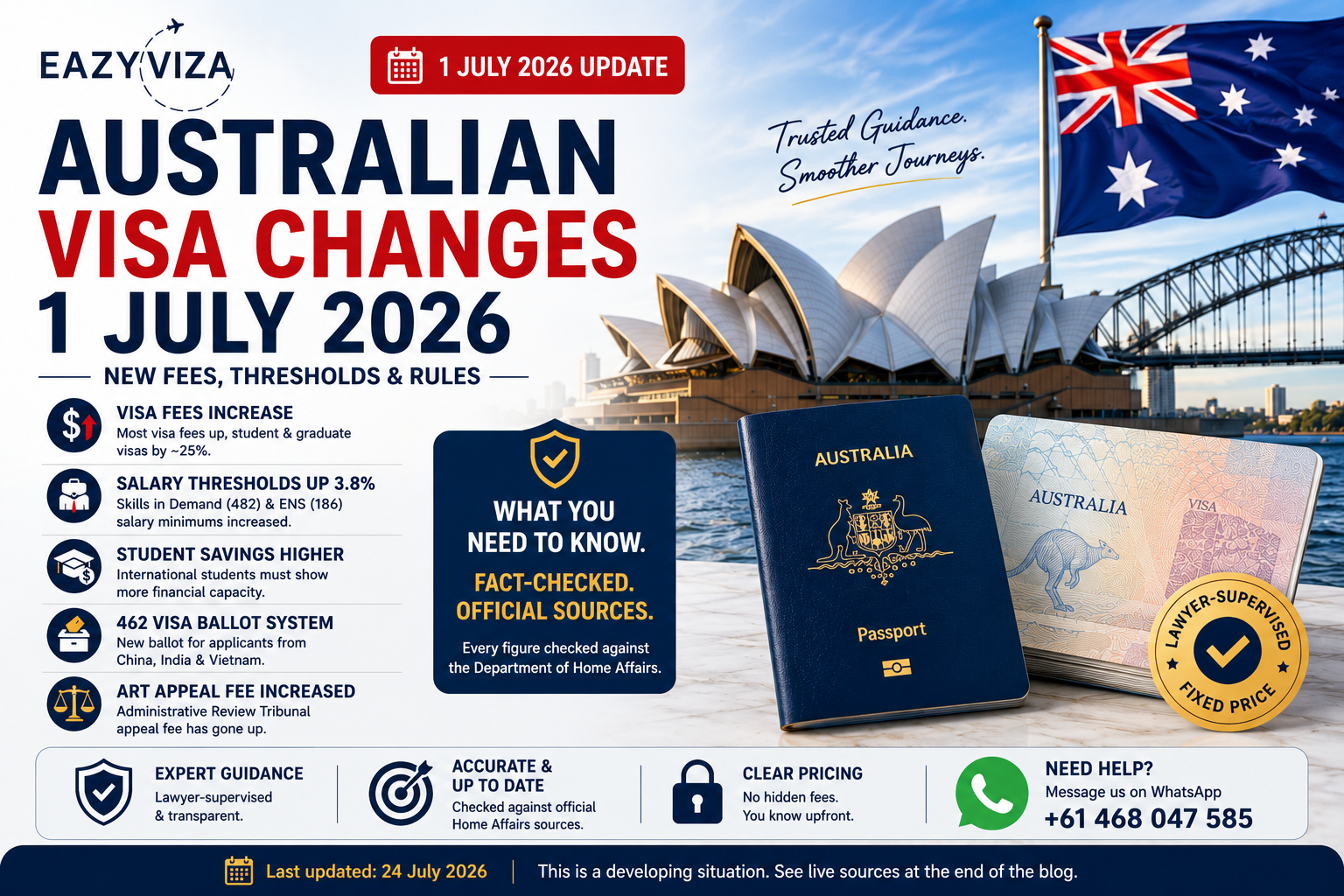
On 1 July 2026, sponsored-worker salary minimums went up 3.8% annually, most visa fees rose (student and graduate visas by roughly 25%), international students now need to show more savings each year, and the 462 working holiday visa moved to a ballot system for applicants from China, India and Vietnam. The Administrative Review Tribunal's appeal fee also increased.
Every figure below is checked against Home Affairs, with a link to the official page for each one. Where a number is still disputed between sources, we say so.
Skilled visa salary thresholds (Skills in Demand 482 and 186)
What changed
When an Australian company sponsors a worker from overseas, it usually uses one of two visas: the Skills in Demand visa (Subclass 482), a temporary sponsored visa (it used to be called "TSS"), or the Employer Nomination Scheme (Subclass 186), a permanent visa many 482 holders move onto later.
The government sets a minimum annual salary for these visas so companies can't underpay sponsored workers. From 1 July 2026, that minimum rose by 3.8%.
| Threshold | Before (to 30 June 2026) | From 1 July 2026 |
|---|---|---|
| Core Skills Income Threshold (CSIT) | $76,515/year | $79,423/year |
| Specialist Skills Income Threshold (SSIT) | $141,210/year | $146,576/year |
Some agent sites are quoting the SSIT as $146,717. The correct figure, confirmed against Home Affairs, is $146,576. Independent confirmation comes from Vialto Partners, RACC, This is Australia Lawyers (Darwin), Peak Migration, and Absolute Immigration, all of whom report $146,576, not $146,717. It's the same rounding slip that produced the earlier $79,499 error on the CSIT. If you've seen $146,717 elsewhere, that source hasn't caught the correction yet.
The Core Skills threshold covers most standard sponsored roles. The Specialist Skills threshold is for higher-paid specialist positions. Either way, the salary offered also has to meet the Annual Market Salary Rate for that job: meeting the threshold alone isn't enough if the market rate for the role is higher.
Before sponsoring anyone, an employer generally also needs to complete Labour Market Testing (showing they tried to hire an Australian first) and hold a Standard Business Sponsorship. Both have their own steps and costs.
Moving from a 482 to a 186 later on is one of the more common paths to permanent residency in Australia, though the timing and cost are worth planning early rather than leaving until your 482 is close to expiring.
Source: Department of Home Affairs, salary requirements to nominate a worker.
Sponsoring or being sponsored on a 482 or 186?
Get a fixed-price, lawyer-supervised review of your nomination before you lodge.
Visa fee increases by subclass
Need expert guidance?
Speak with a migration specialist
Get personalised advice on your visa pathway — response within 2 hours.
The visa application charge (what you pay the government to lodge) went up on most visas from 1 July 2026.
| Visa | Fee change |
|---|---|
| Student Visa (Subclass 500) | Up roughly 25%, the largest increase |
| Temporary Graduate Visa (Subclass 485) | Up roughly 25% |
| Partner Visa (309/820) | Indexed increase |
| Skilled visas (189/190/491) | Up roughly 3% |
| Most other visas | Up roughly 3% |
Students and recent graduates carry the biggest jump this year. Because the exact dollar figure depends on your situation (whether you're bringing a partner or children, for instance), we've deliberately left raw amounts out of this table. The government's own pricing tool, and our own free calculator, give you a live, accurate figure for your case in a few seconds.
Use the official Visa Pricing Estimator for your exact government fee, or our free cost calculator for the full picture including our fees.
If you're comparing costs from India, remember the government fee is set in Australian dollars. Convert from the live AUD figure rather than relying on a fixed rupee amount, since the exchange rate moves.
Source: Department of Home Affairs, fees and charges for visas.
Student visa financial capacity (Subclass 500)
To get a student visa, you need to show you can afford to live in Australia while studying. This is the financial capacity requirement, and the amount went up from 1 July 2026.
| Who | Before | From 1 July 2026 |
|---|---|---|
| Student (main applicant) | $24,505/year | $29,710/year |
| Partner accompanying | $8,574/year | $10,394/year |
| Each accompanying child | $3,670/year | $4,449/year |
| School costs per child (yearly) | $9,661/year | $13,502/year |
You'll also need to meet the Genuine Student (GS) requirement, a short written statement explaining why you want to study in Australia and that you intend to follow your visa conditions. It replaced the older GTE test. A weak or generic GS statement is one of the more common reasons student visas get refused.
Want to work out your full cost, including tuition and living costs together? Try our free cost calculator.
Source: Department of Home Affairs, Student visa (Subclass 500).
The 48-hour work rule
Student visa holders can work up to 48 hours per fortnight while their course is running. During official course breaks, there's generally no limit. This sits under visa condition 8105. Going over it can put your visa at risk, so it's worth tracking your hours properly rather than estimating.
Skilled migration and occupation list updates (189, 190, 491)
Australia's points-tested skilled visas don't always need an employer sponsor:
- Subclass 189: Skilled Independent, no sponsor or state needed.
- Subclass 190: Skilled Nominated, a state or territory nominates you.
- Subclass 491: Skilled Work Regional, requires living and working in a regional area first.
Each uses an occupation list, and your job needs to be on the right one to qualify. These lists get reviewed periodically, so it's worth checking the current version rather than relying on last year's.
491 holders who complete their regional period can move onto the permanent Subclass 191 visa, a path a growing number of regional workers are starting to use as their first 491 grants reach the qualifying stage.
Source: Department of Home Affairs, Skilled Occupation List.
Work and Holiday visa (462) ballot changes
The Work and Holiday visa (Subclass 462) lets people aged 18-30 travel and work in Australia to help fund their trip. For three countries (China, India and Vietnam), first-time applicants now go through a ballot before they can apply at all.
The 2026-27 ballot registration window has already closed. It ran from 4 to 25 June 2026. If you registered, selected applicants receive their invitation to apply between 2 July 2026 and 30 April 2027. If you missed the window, the next one opens with the 2027-28 program year, not before.
| Country | Annual visa cap (number of places) |
|---|---|
| India | 1,000 places/year |
| China | 5,000 places/year |
| Vietnam | 1,500 places/year |
Registration cost a non-refundable $25. Being selected in the ballot isn't the same as holding the visa: you still need to lodge the actual 462 application within your invitation window and pay the separate visa application charge.
One thing people often mix up: this ballot only applies to the 462 visa. The Working Holiday visa (Subclass 417) has no ballot and no cap.
Source: Department of Home Affairs, Work and Holiday (462) pre-application process.
Appeals and refusals, the ART fee increase
If a visa gets refused, you can often ask the Administrative Review Tribunal (ART), which replaced the old AAT, to review the decision. The ART's fees also increased from 1 July 2026.
| Review type | New fee |
|---|---|
| Reviewable migration decision | $3,727 (up from $3,580) |
| Reviewable protection decision | $2,293 |
A 50% reduction is available if you're facing financial hardship. If your visa was refused, check your decision letter for the deadline: the ART can't extend it, so it's worth acting early.
Source: Administrative Review Tribunal, upcoming application fee increase.
Who this affects
- Students: more savings to show (around $29,710/year), a higher fee, and a GS statement that matters more than ever.
- Sponsored workers: the job must now pay at least $79,423/year under the Core Skills threshold.
- Employers: higher minimum salaries, plus the usual sponsorship and labour market testing steps.
- Backpackers: check whether your passport country needs a ballot entry, and note the current window is closed.
- Returning residents: Resident Return Visa (RRV, Subclass 155) fees were part of the same update. Check the current cost before booking travel.
Want a full breakdown of what your specific visa will cost, including our fees? Try our free cost calculator.
This page reflects publicly reported figures as of 24 July 2026 and will be updated if Home Affairs revises any of the amounts above.
Frequently asked questions
How much did Australian visa fees increase in July 2026?
Most visa fees rose by about 3% from 1 July 2026. Student (Subclass 500) and Temporary Graduate (Subclass 485) fees rose by about 25%, the largest increase. Check the official Visa Pricing Estimator or our free cost calculator for your exact fee.
What is the new 482 salary threshold for 2026?
The Core Skills Income Threshold rose from $76,515 to $79,423 per year, and the Specialist Skills Income Threshold rose from $141,210 to $146,576 per year, both from 1 July 2026.
How much money do international students need to show in 2026?
Student visa applicants must show about $29,710 in living costs for 12 months, plus $10,394 for a partner and $4,449 per child, each year.
Is the 462 ballot still open?
No. The 2026-27 registration window closed on 25 June 2026. Selected applicants are invited to apply between 2 July 2026 and 30 April 2027. The next window opens for the 2027-28 program year.
How much did the ART appeal fee increase to?
The fee for reviewing a migration decision rose to $3,727 from 1 July 2026, up from $3,580. A 50% hardship reduction may be available.
How many hours can I work on a student visa?
Up to 48 hours per fortnight while your course is running. No limit during official course breaks.