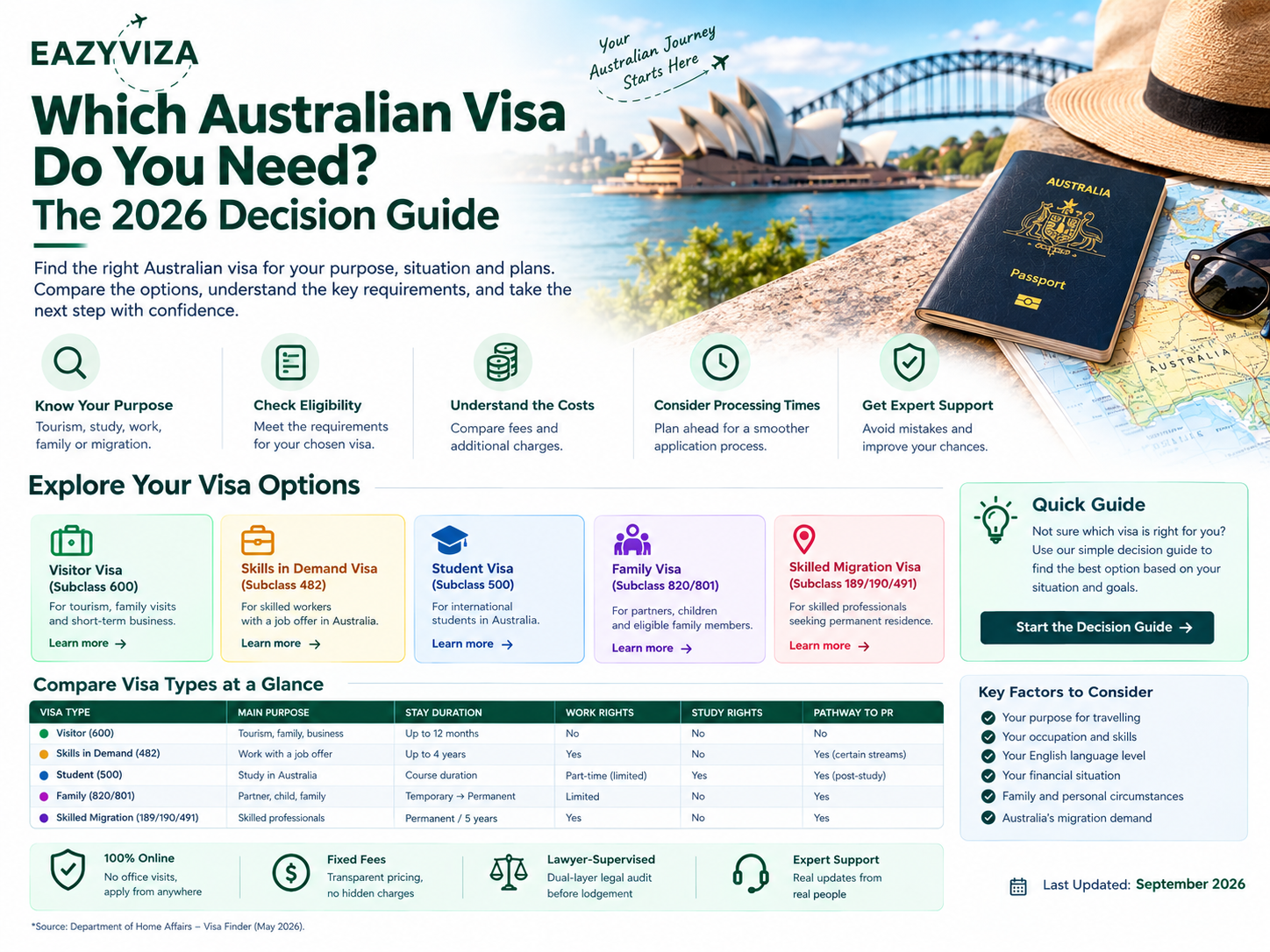
Australia has more than 200 visa types. You do not need to know any of the numbers. What you need to know is why you want to go. Your reason tells you which visa to apply for. This guide takes you through five simple purposes, shows you what each visa costs, how long it takes, and links you to the right page to go deeper or apply. Start with the tree below, then scroll to the section that matches you.
How to use this page: Find your reason for going to Australia in the decision tree below. Then read that section for your visa options, costs, and next steps. If you are still unsure after reading, use our free eligibility checker — it takes two minutes and tells you exactly where you stand. Source: Home Affairs, Can I go to Australia?
Why Are You Going to Australia? Pick Your Path
Australia's 2025-26 Migration Programme: The Numbers
Need expert guidance?
Speak with a migration specialist
Get personalised advice on your visa pathway — response within 2 hours.
Australia set aside 185,000 permanent migration places for 2025-26, alongside a separately allocated 20,000 Humanitarian Program intake. Here is how those places are shared out. If your goal is permanent residency, there is a spot for you — the question is simply which pathway gets you there.
Source: Home Affairs, skilled migration program 2025-26.
The Five Pathways Explained
Going to Australia for a Holiday or to See Family
This is the most common reason people from India, the Philippines, and Sri Lanka apply for an Australian visa. Whether you want to see Sydney, attend a wedding, or visit your child who lives in Australia, you are in the visitor category.
Which visa depends on your passport:
- Subclass 600 Tourist visa — open to any nationality. Costs AUD 250. Can allow a stay of up to 12 months. This is the main option for Indian, Filipino, Sri Lankan, and Nepali passport holders.
- eVisitor (651) — only for people with an eligible European passport. Completely free. Can enter multiple times over 12 months, up to 3 months each visit.
- ETA (601) — for US, Canadian, Japanese, and Singapore passport holders, among others. Costs AUD 20. Applied through the Australian ETA app.
India passport holders: The eVisitor and ETA are not available to you. Subclass 600 is your primary path. If your passport is from India and your family member has a European passport (for example, your partner), they use eVisitor while you apply for Subclass 600 separately.
How long does it take? Most Tourist stream applications are decided in about 16 days. 90% are done within 33 days. The Sponsored Family stream (when a relative in Australia formally sponsors you) takes a median of 38 days.
The genuine visitor requirement: Every Subclass 600 application is assessed under clause 600.211 of the Migration Regulations 1994. In plain terms: the case officer needs to be satisfied you genuinely plan to leave Australia when your visa period ends. Strong ties to your home country, a clear trip purpose, and documents that all tell the same story are what builds that case.
Full Visitor Visa guide → · eVisitor vs Subclass 600 → · Guide for Indian applicants → · Apply with EazyViza → · Free Visitor Visa Toolkit →
Going to Australia to Work
Australia needs skilled workers. If you have a job offer from an Australian employer, or if your skills and experience let you apply independently, there is a visa for you. The right one depends on whether an employer is sponsoring you or whether you are applying on your own.
If an employer is sponsoring you:
- Skills in Demand visa (482) — the main employer-sponsored work visa. Your employer hires you, sponsors your visa, and you can work in Australia temporarily. Costs AUD 4,015. You can apply for permanent residency (Subclass 186) after 2 years with the same employer. Salary thresholds must meet the required TSMIT / Core Skills thresholds.
- Employer Nomination Scheme (186) — goes straight to permanent residency via your employer. Either after 2 years on a 482 visa (TRT pathway) or directly if you have a skills assessment (Direct Entry pathway).
If you are applying on your own (no employer needed):
- Skilled Independent (189) — points-tested. No employer, no state needed. Grants permanent residency directly.
- Skilled Nominated (190) — a state or territory nominates you, which adds 5 points. Also grants permanent residency directly.
- Skilled Regional (491) — requires state or family nomination. Provisional visa first, then PR after 3 years.
Working Holiday: If you are aged 18 to 35, the Working Holiday visa (417 or 462) lets you work and travel in Australia for up to a year. India is eligible for the 462 Working Holiday visa with an annual ballot process.
Processing: Priority processing applies to essential sectors such as healthcare, construction, and education. Processing ranges from 2 weeks to 6 months depending on your occupation, sponsor status, and application location.
Full Skills in Demand (482) guide → · 482 application service → · Skilled Independent (189) service → · Skilled Nominated (190) service → · Working Holiday service →
Going to Australia to Study
If you have enrolled in a course at an Australian institution, you need a Student visa. You cannot study for more than 3 months on a visitor visa, and a visitor visa does not let you work. The Student visa is the right option.
- Student visa (500) — for any full-time course at a CRICOS-registered institution (university, college, school, TAFE). Costs AUD 2,000. You can work up to 48 hours per two weeks while your course is running, and unlimited hours during official course breaks.
- Student Guardian (590) — for a parent or relative who needs to come to Australia to look after a student child under 18.
- Training visa (407) — for work-based professional training programs, not academic study.
Genuine Student requirement: The Genuine Student (GS) requirement applies to Student visa applications. Applicants answer targeted, structured questions inside the application form detailing their choice of course, career goals, and circumstances. Source: Home Affairs, Genuine Student requirement.
Document Verification: High standards apply across all regional student markets. Your academic records, financial proof, and English test results must be verified, thorough, and consistent.
Path to permanent residency after study: Student visa (500) leads to Temporary Graduate visa (485) after graduation, which can transition toward employer-sponsored work (482) or independent skilled migration (189 or 190).
Overseas Student Health Cover (OSHC) is mandatory for every student for the full duration of their course stay in Australia.
Student visa (500) service → · Temporary Graduate (485) service →
Going to Australia to Live with a Partner or Family Member
If someone close to you is an Australian citizen or permanent resident and you want to live with them in Australia, this is your pathway. The right visa depends on your relationship type and whether you are applying inside Australia or from overseas.
Partner visas (married or de facto):
- Partner visa (820/801) onshore — apply from inside Australia. Costs AUD 8,085. You receive a bridging visa allowing you to stay and work while your application is processed. After meeting stage requirements, you become a permanent resident (801).
- Partner visa (309/100) offshore — apply from your home country. Costs AUD 8,085. Standard pathway for overseas applicants coming to join a partner in Australia.
Both pathways require proving your relationship is genuine and continuing under regulation 1.09A of the Migration Regulations 1994. Key evidence includes financial aspects, nature of the household, social context, and long-term commitment.
Parent visas:
- Parent visa (143 Contributory) — for parents of settled Australian citizens or PRs. Requires higher contribution fees per applicant but has faster processing queues than non-contributory categories.
- Parent visa (103 Standard) — lower initial cost but involves very long processing queues.
Child visas: If your child is outside Australia and you are an Australian citizen or PR, child visas (101 or 102) allow them to join you.
Partner visa 820 onshore service → · Partner visa 309 offshore service →
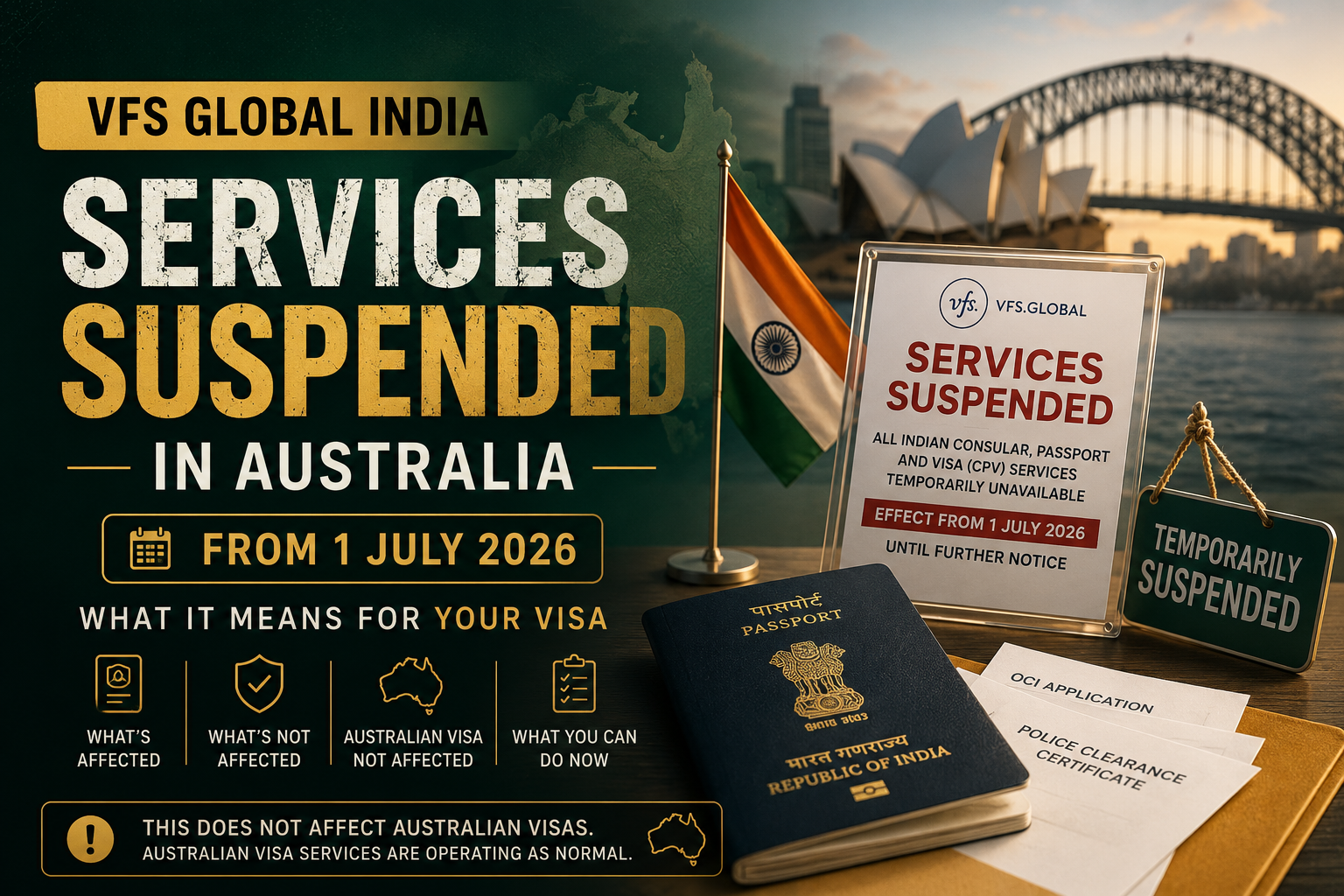
OCI Cards, Indian Passport Renewal, and VFS Services
This section is specifically for Indian nationals and persons of Indian origin residing in Australia who need assistance with OCI cards, consular document clearance, or passport updates alongside their Australian visa application.
What is an OCI card? An Overseas Citizen of India (OCI) card provides lifelong entry to India for foreign citizens of Indian origin. It is issued by the Indian Government and acts independently of Australian visa status. To enter Australia, you still require a valid Australian visa or passport.
VFS Global Consular Services: VFS Global operates official Indian Visa and Consular Application Centres across Australian capitals (Sydney, Melbourne, Perth, Brisbane, Adelaide, Canberra) handling OCI, passport renewals, and Indian Police Clearance Certificates (PCC). If your Australian visa application requires an Indian Police Check or updated passport details, booking your VFS appointment promptly ensures your Australian ImmiAccount processing stays on schedule. Need urgent guidance? Contact our team on WhatsApp.
What Does Each Visa Cost and How Long Does It Take?
| Your reason for going | Visa | Cost | How long to get | Can lead to permanent residency? |
|---|---|---|---|---|
| Holiday or family visit (any country) | Subclass 600 Tourist | AUD 250 | 16 to 33 days | No |
| Holiday (European passport) | eVisitor 651 | Free | 24 to 48 hours | No |
| Work — employer sponsors you | 482 Skills in Demand | AUD 4,015 | 2 weeks to 6 months | Yes — via Subclass 186 after 2 years |
| Work — no employer, apply yourself | 189 Skilled Independent | AUD 4,640 | Depends on invitation rounds | Yes — permanent visa directly |
| Study | 500 Student | AUD 2,000 | Varies by sector | No (leads to graduate visa pathway) |
| Live with partner (in Australia) | 820/801 Partner onshore | AUD 8,085 | 17 to 24 months | Yes — after 2-stage processing |
| Live with partner (from home country) | 309/100 Partner offshore | AUD 8,085 | 15 to 25 months | Yes — after 2-stage processing |
| Parent of Australian citizen or PR | 143 Contributory Parent | AUD 48,430+ | Multi-year queue | Yes — permanent visa directly |
All fee estimates align with the official Home Affairs Visa Pricing Estimator. Always verify final VAC amounts before lodging. Use our cost calculator to estimate your overall budget including professional management fees.
Questions People Ask Most Often
It is Australia's standard short-stay visa for people visiting for a holiday, visiting family, or conducting short business activities. Open to all passport holders, it costs AUD 250 for offshore lodgements. Most applications are processed within 16 to 33 days. Passport holders not eligible for eVisitor or ETA rely on Subclass 600. See the full Subclass 600 guide.
It is Australia's primary employer-sponsored temporary work visa. An approved Australian business sponsors the worker for an eligible occupation. After completing 2 years on a 482 visa with an eligible employer, applicants become eligible to apply for permanent residency via Subclass 186. See the full 482 guide.
It is the visa category for spouses or de facto partners of Australian citizens, permanent residents, or eligible New Zealand citizens. Onshore applications (820/801) include a Bridging Visa to remain in Australia during processing, while offshore applications (309/100) are lodged from overseas. Both cost AUD 8,085 and follow a two-stage pathway to permanent residency. Evidence must demonstrate a genuine, exclusive relationship. See our 820 service or 309 service.
It allows international students to undertake full-time CRICOS-registered study in Australia. Application fees are AUD 2,000. Students are permitted to work up to 48 hours per fortnight while course sessions are active and unlimited hours during breaks. Comprehensive Overseas Student Health Cover (OSHC) is mandatory. Applicants must meet Genuine Student standards. See our Student visa service.
If you are currently inside Australia on a valid visa without no-further-stay conditions, lodging an onshore Partner visa (820/801) provides an immediate Bridging Visa with work rights while decision-making occurs. If you are outside Australia, the offshore Partner visa (309/100) is the dedicated permanent pathway.
Frequently asked questions
What is the Subclass 600 visitor visa in Australia?
The Subclass 600 is Australia's standard temporary visitor visa available to any nationality. It covers tourism, family visits, and short business activities. The Tourist stream costs AUD 250 offshore (from 1 July 2026), can grant up to 12 months per stay, and is applied through ImmiAccount. Indian, Filipino, and Sri Lankan passport holders must use this visa since the eVisitor (651) and ETA (601) are not available to them.
What is the Skills in Demand visa (482) in Australia?
The Skills in Demand visa (Subclass 482) is Australia's employer-sponsored temporary work visa, replacing the old TSS visa on 7 December 2024. Three streams based on salary: Specialist Skills (above AUD 146,576), Core Skills (above AUD 79,423 on the CSOL), and Labour Agreement. It leads to permanent residency via the Subclass 186 Employer Nomination Scheme after two continuous years with the same nominating employer.
What is a partner visa in Australia?
A partner visa allows the spouse or de facto partner of an Australian citizen or permanent resident to live and work in Australia permanently. The onshore version (820/801) is for applicants already in Australia. The offshore version (309/100) is for applicants applying from their home country. Both cost AUD 8,085 at the base rate, take 15-25 months, and require evidence of a genuine relationship under regulation 1.09A of the Migration Regulations 1994.
What is the Student visa (Subclass 500) in Australia?
The Student visa (Subclass 500) allows international students to study full-time in a CRICOS-registered Australian institution. It costs AUD 2,000 and permits work of up to 48 hours per fortnight during semester, with unrestricted hours during scheduled breaks. The Genuine Student (GS) requirement replaced the Genuine Temporary Entrant (GTE) test for all applications lodged from 23 March 2024. Overseas Student Health Cover (OSHC) is mandatory for the full course duration.
What is the difference between a temporary Australian visa and permanent residency?
A temporary visa grants the right to be in Australia for a specific period and purpose. A permanent resident can live and work in Australia indefinitely, access most government services, and sponsor eligible family members. Permanent residents can apply for Australian citizenship after four years of residence, including at least one year as a PR. Most PR pathways start with a temporary visa: the 482 leads to the 186, the student visa leads to the 485 then the 482 or 189, and the partner temporary visa leads to the partner permanent.
Does an OCI card mean I do not need an Australian visa?
No. An OCI (Overseas Citizen of India) card is a lifelong visa for India, issued by the Government of India. It does not grant any rights to enter, live, or work in Australia. Every OCI holder needs a separate Australian visa for any visit or stay in Australia. The two systems are completely independent.
Can I move to Australia without a job offer?
Yes, through the points-tested skilled migration pathway. The Skilled Independent visa (Subclass 189) and the Skilled Nominated visa (Subclass 190) do not require an employer. You need a qualifying occupation on the relevant skilled occupation list, a positive skills assessment, and enough points on the points test to receive an invitation through SkillSelect. Both grant direct permanent residency.
What is the Employer Nomination Scheme (186) visa in Australia?
The Employer Nomination Scheme (Subclass 186) is a permanent residency visa granted through employer sponsorship. It has two streams: the Temporary Residence Transition (TRT) stream, available after two continuous years on a 482 visa with the same nominating employer, and the Direct Entry stream, available without a prior 482 visa for applicants with a skills assessment and an eligible occupation. It is one of Australia's most direct employer-sponsored pathways to permanent residency.