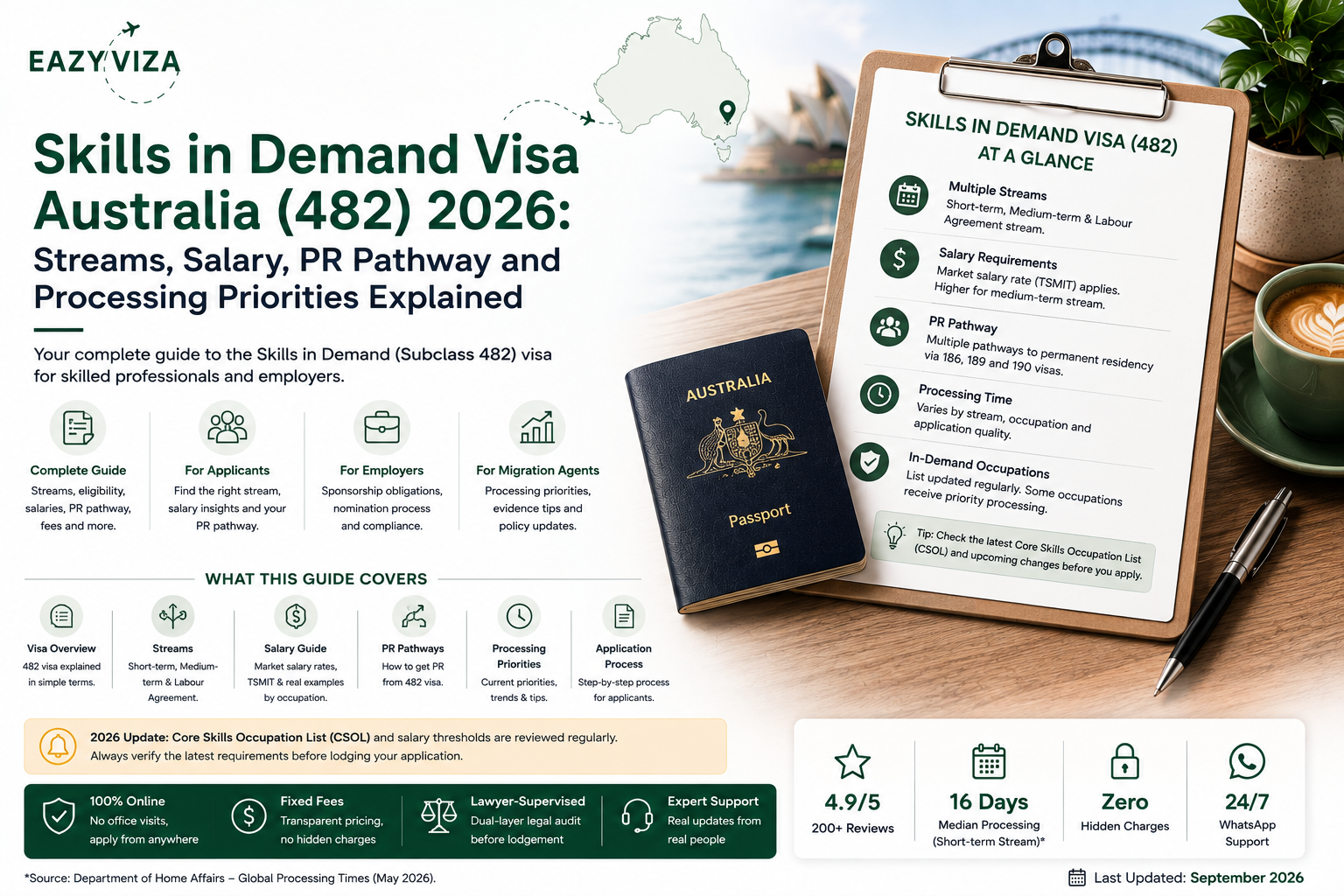
If you are a skilled worker trying to build a career in Australia, or an employer who cannot fill a role locally, the Skills in Demand visa (Subclass 482) is almost certainly the pathway you have landed on. It is Australia's primary employer-sponsored temporary work visa and it has changed more in the past two years than in the decade before that. In December 2024, the government rebuilt the entire framework, replacing the old Temporary Skill Shortage (TSS) structure with three salary-based streams. In July 2025, it changed the conditions that govern whether you can change employers. In July 2026, salary thresholds increased. And in July 2026, Ministerial Direction 119 changed which applications get processed first, directly affecting how long offshore applicants from India and the Philippines wait compared to those already in Australia.
This guide is current to August 2026. It covers the three streams, updated salary thresholds, processing priorities under Ministerial Direction 119, the employer change rules, the PR pathway via Subclass 186, and what applicants from India and the Philippines specifically need to know. For the full 186 pathway, including the Temporary Residence Transition and Direct Entry streams in depth, see our dedicated guide after reading this post.
Quick answer: The Skills in Demand visa (Subclass 482) has three streams: Specialist Skills (salary above AUD 146,576, no occupation list), Core Skills (salary above AUD 79,423, occupation on the CSOL), and Labour Agreement (employer has a formal government agreement). Your stream determines your salary floor, your occupation options, and your route to permanent residency. From 25 July 2026, Ministerial Direction 119 prioritises healthcare, construction and teaching workers, and applicants already in Australia are processed before offshore applicants. Verify current thresholds at the Home Affairs Visa Pricing Estimator before lodging.
What the Skills in Demand Visa (Subclass 482) Actually Is
The Skills in Demand visa allows an approved Australian employer to sponsor an overseas worker for a role they cannot fill with a suitably qualified Australian. It sits inside a three-step employer sponsorship system: the employer first becomes an Approved Standard Business Sponsor (SBS), then nominates the specific position, and then the worker applies for the visa. All three steps run through ImmiAccount at immi.homeaffairs.gov.au.
The Skills in Demand (SID) name replaced the old "TSS" label when the new framework launched on 7 December 2024. The subclass number, 482, did not change. What changed is almost everything underneath it: the occupation eligibility system, the salary thresholds, the mobility rights for visa holders, and the pathways to permanent residency. An application made under the old TSS framework before December 2024 was assessed under different rules. Every new application is assessed under the Skills in Demand framework described below.
The Three Streams: Which One Applies to You
Need expert guidance?
Speak with a migration specialist
Get personalised advice on your visa pathway — response within 2 hours.
Your stream is the single most consequential decision in a 482 application. It determines your salary floor, your occupation options, your visa duration, and how long you wait for a decision. The three streams do not overlap — you fit exactly one of them based on your occupation and the salary your employer is offering.
| Feature | Specialist Skills Stream | Core Skills Stream | Labour Agreement Stream |
|---|---|---|---|
| Salary floor (from 1 July 2026) | AUD 146,576 (SSIT) | AUD 79,423 (CSIT) | Set by the labour agreement — may be lower than CSIT with concessions |
| Occupation requirement | No restricted list — but trade workers, machinery operators, drivers and labourers are excluded | Occupation must appear on the Core Skills Occupation List (CSOL), which covers 456 occupations | Occupation must be approved under the relevant agreement |
| Annual places | Capped at 3,000 per year — applies early in the financial year | Uncapped | Uncapped within agreement terms |
| Visa duration | Up to 4 years | Up to 4 years | Up to 4 years (or agreement term) |
| Labour market testing required? | No | Yes (unless exempt) | Varies by agreement |
| PR pathway available? | Yes, via Subclass 186 (Direct Entry or TRT after 2 years) | Yes, via Subclass 186 (TRT after 2 years) | Yes, via Subclass 186 |
| Processing priority under Ministerial Direction 119 (from 25 July 2026) | Onshore applicants prioritised over offshore | Healthcare, construction and teaching occupations prioritised; onshore over offshore | Standard processing |
Source: Home Affairs, Skills in Demand visa (Subclass 482); Home Affairs, Skilled visa processing priorities (Ministerial Direction 119, 25 July 2026).
Ministerial Direction 119: The Processing Priority Change Most Applicants Don't Know About
On 25 July 2026 — less than three weeks after this page was originally published — Ministerial Direction 119 came into effect and changed how 482 applications are queued for assessment. This is the most significant operational update to the Skills in Demand visa since the framework launched in December 2024, and it directly affects how long you wait.
The practical implication for applicants from India and the Philippines: if your occupation falls in Tier 2 (healthcare, construction, teaching), your application is prioritised. If it does not, and you are applying from outside Australia, you sit behind every onshore applicant in any tier. If you are currently in Australia on a different visa and your occupation and salary clear the 482 threshold, lodging onshore rather than returning home first gives you a material processing advantage.
482 Visa Eligibility Requirements: What You and Your Employer Both Need
A 482 application involves two simultaneous assessments — one for the employer (sponsorship and nomination) and one for you (the visa application). Both must pass. A strong personal file cannot overcome a deficient nomination, and vice versa.
What the employer needs
- Approved Standard Business Sponsor (SBS) status or an application in progress — applying for SBS can add four to five months to the timeline if the employer has never sponsored before.
- Approved nomination for the specific position, including confirmation that the salary meets both the stream threshold and the Annual Market Salary Rate (AMSR) for the role and location, whichever is higher.
- Labour Market Testing (LMT) for most Core Skills stream positions — evidence that no suitable Australian was available for the role. UK passport holders are exempt from LMT requirements under the Australia-UK Free Trade Agreement since 31 May 2023.
- SAF Levy payment — AUD 1,200 per year of the visa for businesses with annual turnover under AUD 10 million; AUD 1,800 per year for larger businesses. Australian law prohibits employers from passing any part of this cost to the visa applicant.
What you need
- At least one year of relevant work experience in your nominated occupation.
- Relevant qualifications for the role.
- A mandatory skills assessment if your occupation requires one — for trades and some healthcare roles, this must be completed before visa lodgement.
- Competent English — at minimum an IELTS overall score of 5.0 in each band, or equivalent in PTE Academic, TOEFL iBT, OET, CELPIP, LANGUAGECERT, or MET. Passport holders from the UK, USA, Canada, New Zealand and Ireland are generally exempt.
- Health and character requirements met for you and any included family members.
- Licensing or registration in Australia if your occupation is regulated — nursing, engineering, medicine, and several other professions require this before you can work.
Which Occupations Qualify: The CSOL and the Corridor Reality
The Core Skills Occupation List (CSOL) covers 456 occupations including roles across healthcare, information technology, engineering, education, trades, and accounting. If your occupation is not on the CSOL, you either need your offered salary to clear the SSIT threshold (Specialist Skills stream) or your employer needs a Labour Agreement. The CSOL is updated periodically — check the live list at the Home Affairs skilled occupation list page before assuming your role qualifies.
Indian Applicants: Most Common 482 Occupations
- Software and applications programmers
- ICT project managers and business analysts
- Registered nurses (requires AHPRA registration)
- Civil and structural engineers
- Accountants and auditors
- Database and systems administrators
Filipino Applicants: Most Common 482 Occupations
- Registered nurses (aged care, acute and community settings)
- Personal care workers and support workers
- Chefs and cooks
- Civil engineers and drafting professionals
- Accountants and financial analysts
- Early childhood educators
482 Visa Fees and Costs in 2026
Visa Application Charges increased significantly from 1 July 2026. These are the current figures applicable to applications lodged from 1 July 2026 onward.
| Applicant category | VAC from 1 July 2026 |
|---|---|
| Primary applicant (all streams) | AUD 4,015 |
| Secondary applicant aged 18 or over (partner or adult dependant) | AUD 4,015 |
| Dependent child under 18 | AUD 1,005 |
| Onshore subsequent temporary application charge (per person) | Approx. AUD 700 |
| Standard Business Sponsorship (employer, one-off) | AUD 420 |
| Nomination fee (employer, per position) | AUD 330 |
| SAF Levy (employer, business turnover under AUD 10 million) | AUD 1,200 per visa year |
| SAF Levy (employer, business turnover AUD 10 million or more) | AUD 1,800 per visa year |
Budget additionally for: health examination, English test (if required), skills assessment fee (occupation-dependent, typically AUD 500 to AUD 1,500), police clearance certificates, and document translations. Use the Home Affairs Visa Pricing Estimator to confirm the current VAC before payment. Source: Home Affairs Legislation Amendment (2026 Measures No. 1) Regulations.
Under Australian law, employers cannot pass SAF Levy costs to visa applicants. The nomination fee, sponsorship fee, and SAF Levy are the employer's legal obligation. If an employer asks you to contribute to or reimburse these costs, that is a violation of Australian migration law. Contact our team if this has happened to you.
Processing Times Under Ministerial Direction 119
Processing times vary significantly by stream, occupation, and whether you are applying onshore or offshore. The benchmarks below reflect conditions after Ministerial Direction 119 took effect on 25 July 2026.
- Specialist Skills stream, onshore: Often 7 to 11 business days for priority cases; up to 2 months for standard cases.
- Specialist Skills stream, offshore: 1 to 3 months for most occupations, longer if skills assessment is required.
- Core Skills stream, onshore (healthcare, construction, teaching): 1 to 2 months typically.
- Core Skills stream, offshore (Tier 2 occupations): 2 to 4 months.
- Core Skills stream, offshore (Tier 3 occupations): 3 to 6 months or longer during high-volume periods.
- Labour Agreement stream: 3 to 8 months across all cases due to additional agreement verification.
- New sponsorship applications: Add 4 to 5 months if your employer has not previously been approved as a sponsor.
Source: Home Affairs global processing times tool. Check the live tool before planning travel or start dates as these figures shift monthly.
Can I Change Employers on a 482 Visa? The Mobility Rules Explained
This is the most-asked question on r/AusVisa among 482 holders, and the answer changed meaningfully in mid-2024 when conditions 8107, 8607, and 8608 were updated. Understanding this correctly matters even more if your goal is permanent residency.
Under the old framework, changing employers effectively meant starting your visa process from scratch. Under the current Skills in Demand framework, you have more flexibility, but there are conditions that matter significantly for anyone planning a PR pathway.
What you can now do
- Your employer must lodge a new nomination for the new position and the new employer must be or become an Approved Standard Business Sponsor.
- Once the new nomination is approved and linked to your existing 482 visa, you can work for the new employer. Your existing visa does not expire when you change employers — it remains active while the new nomination is being processed.
- You have a bridging period during which you can remain in Australia while the new sponsorship is being arranged, though you should not wait too long to begin that process after leaving an employer.
The PR implication that most guides get wrong
Under the Subclass 186 Temporary Residence Transition (TRT) pathway, the two years of continuous employment that qualifies you for PR must be with the nominating employer. If you change employers, the clock for the new employer starts only from when the new nomination is lodged and approved, not from when you started informally working for them or from your original 482 grant date.
This means changing employers can delay your PR eligibility by 12 to 24 months depending on timing. If PR is your goal and you are approaching your two-year mark with your current sponsor, the decision to change employers deserves careful planning before you resign.
Source: Home Affairs, Skills in Demand visa — change in situation; confirmed against published analysis by KPMG and RACC Migration (February 2026).
From 482 Visa to Permanent Residency: The Two Pathways
Permanent residency is achievable from the 482 visa. Most applicants use one of two routes under the Employer Nomination Scheme (Subclass 186), with a third option available through independent skilled visas for some occupations.
Temporary Residence Transition (TRT) pathway
After working for two continuous years in your nominated role with your nominating employer, you become eligible to apply for Subclass 186 via the TRT stream. Your employer nominates you, you apply, and if granted, you receive permanent residency. Your family members included in your 482 application can be included in your 186 application. This is the most common pathway for 482 holders from India and the Philippines. For the full TRT eligibility requirements, age limits, and document checklist, a dedicated guide is available separately.
Direct Entry pathway
The Direct Entry stream of Subclass 186 does not require a prior 482 visa. If your occupation is on the relevant ENS occupation list and you hold a positive skills assessment, you can apply directly for permanent residency through an employer nomination without having first held a 482. This is more commonly used by applicants in healthcare and engineering who have completed overseas skills assessments and have a willing employer sponsor.
The most common mistake is treating the 482 and the 186 as separate projects. The decisions you make on your 482 application — which employer you choose, which occupation you nominate, how you structure your employment contract — directly affect your eligibility timeline for the 186. EazyViza can map both steps together in an initial migration consultation before you lodge the first application.
Bringing Your Family to Australia on a 482 Visa
Your partner and dependent children can be included as secondary applicants in your 482 application. Once granted, your partner receives full work rights in Australia — they can work for any employer in any occupation, with no stream or salary restrictions. Children under 18 can attend Australian schools. One rule applies without exception: family members cannot be added to an application after it has been lodged. If a family member is not included at lodgement, they must apply separately as a subsequent entrant later, which is a slower and more expensive process. If you are already in Australia on a 482 visa and need to bring a family member across, our team can walk you through the subsequent entrant process.
Common Reasons 482 Visa Applications Are Refused
Refusals almost always come down to a small set of avoidable errors. The most frequent across Indian and Filipino applicants specifically:
- The nominated salary falls below the CSIT or SSIT, or below the AMSR for the role and location, whichever is higher — even by a small margin.
- The nominated occupation does not genuinely match the applicant's duties on the day-to-day job description submitted.
- A mandatory skills assessment was not completed before lodgement.
- English test results have expired (most tests are valid for 3 years) or do not reach the required score in each band.
- Employment history or qualifications are inconsistently documented across the nomination form and the visa application.
- The sponsoring employer has outstanding compliance obligations or does not yet hold approved SBS status.
- Salary evidence does not clearly show the offered salary meeting both the threshold and the AMSR — a letter of offer alone is often not sufficient without supporting payroll evidence.
If your application has already been refused, or if you received a request for further information that you are not sure how to respond to, our refusal review service can identify what went wrong and what your realistic options are from there.
A 482 application touches employer sponsorship, occupation matching, salary benchmarking, skills assessment, English testing, and a full document package — often simultaneously. Getting one element wrong can delay or refuse an otherwise strong application. EazyViza's lawyer-supervised team works with both applicants and employers across the entire process, from an initial eligibility check through to VEVO verification after your visa is granted.
Last reviewed: September 2026. Salary thresholds (AUD 79,423 CSIT and AUD 146,576 SSIT) verified against Home Affairs guidance. Ministerial Direction 119 processing priorities confirmed effective 25 July 2026. Employer change rules confirmed against KPMG Flash Alert 2026-069 and Home Affairs conditions update (8107, 8607, 8608). Always verify current thresholds and occupation list status at immi.homeaffairs.gov.au before lodging.
Frequently asked questions
What is the Skills in Demand visa (482) in Australia?
The Skills in Demand visa (Subclass 482) is Australia's primary employer-sponsored temporary work visa. It allows an approved Australian employer to sponsor a skilled overseas worker for a role they cannot fill locally. It replaced the Temporary Skill Shortage (TSS) visa framework when the Skills in Demand structure launched on 7 December 2024. The three streams — Specialist Skills, Core Skills, and Labour Agreement — are determined by the worker's salary and occupation.
What are the salary thresholds for the 482 visa in 2026?
From 1 July 2026, the Core Skills Income Threshold (CSIT) is AUD 79,423 per year for the Core Skills stream. The Specialist Skills Income Threshold (SSIT) is AUD 146,576 per year for the Specialist Skills stream. Both thresholds are indexed annually. The employer must also pay the Annual Market Salary Rate (AMSR) for the role and location if it exceeds the stream threshold. Verify current figures at the Home Affairs Visa Pricing Estimator before lodging.
Can I change employers on a 482 visa in Australia?
Yes, under the current Skills in Demand framework. Your new employer must lodge a new nomination linked to your existing visa. Your existing visa remains active while the new nomination is processed. However, if your goal is permanent residency via the Subclass 186 Temporary Residence Transition pathway, the two-year continuous employment requirement starts only from when the new nomination is lodged and approved — not from your original 482 grant date. Changing employers can delay PR eligibility by 12 to 24 months.
What is Ministerial Direction 119 and how does it affect 482 visa processing?
Ministerial Direction 119 came into effect on 25 July 2026 and changed how 482 applications are prioritised for assessment. For the first time, the Skills in Demand (482) program is explicitly included in the priority framework. Healthcare, construction, and teaching occupations receive higher processing priority. Within every tier, applicants already in Australia are processed before offshore applicants. This means an Indian applicant in a Tier 3 occupation applying offshore waits longer than an onshore applicant in any tier.
How long does it take to get a 482 visa in 2026?
Under Ministerial Direction 119, processing times depend on occupation and whether you are onshore or offshore. Specialist Skills stream onshore cases are often decided in 7 to 11 business days. Core Skills stream offshore cases in healthcare, construction, and teaching typically take 1 to 3 months. Other Core Skills offshore cases take 3 to 6 months or longer during peak periods. Labour Agreement stream cases take 3 to 8 months. If your employer is not yet an Approved Sponsor, add 4 to 5 months.
How do I go from a 482 visa to permanent residency/PR in Australia?
The most common pathway is the Subclass 186 Employer Nomination Scheme via the Temporary Residence Transition stream. After working continuously for two years in your nominated role with your nominating employer, your employer nominates you for the 186 and you apply for permanent residency. The Direct Entry stream of the 186 visa does not require a prior 482 visa — it is available to applicants with a positive skills assessment and an eligible occupation, regardless of their current visa.
What is the SAF Levy and does the applicant have to pay it?
The Skilling Australians Fund (SAF) Levy is a mandatory payment by the sponsoring employer. It is AUD 1,200 per year of the visa for businesses with annual turnover under AUD 10 million, and AUD 1,800 per year for larger businesses. Under Australian law, employers cannot legally pass this cost to the visa applicant. If your employer asks you to contribute to or reimburse the SAF Levy, this is a violation of Australian migration law.
Can my partner work in Australia on a 482 visa?
Yes. Secondary applicants (partners and dependent children) included in a 482 visa application receive full work rights in Australia once the visa is granted. Partners can work for any employer in any occupation with no stream or salary restrictions. Dependent children can attend Australian schools. Family members must be included in the original application at lodgement — they cannot be added afterward.
What occupations are on the 482 Core Skills Occupation List?
The Core Skills Occupation List (CSOL) covers 456 occupations across healthcare, information technology, engineering, education, trades, accounting, and other sectors. It is updated periodically by the Department of Home Affairs. If your occupation is not on the CSOL, you either need your salary to clear the Specialist Skills Income Threshold (AUD 146,576 from 1 July 2026) or your employer needs a Labour Agreement. Check the live list at immi.homeaffairs.gov.au before assuming your occupation qualifies.
What happens if my 482 visa application is refused?
You receive a formal written decision stating the grounds for refusal. Review rights depend on your stream and your location at the time of lodgement. If a review is available, strict timeframes apply and missing the deadline removes that right. A re-application should address the specific grounds stated in the refusal notice, not simply resubmit the same documents. The most common grounds include salary falling below the threshold or AMSR, occupation mismatch, expired English results, and incomplete skills assessments.