The most common first step people take when researching the 482 visa is searching for a list of approved sponsors in Australia. There is not one. The Department of Home Affairs does not publish a register of Standard Business Sponsors. Multiple Freedom of Information requests to Home Affairs have confirmed this over the years. New Zealand makes its accredited employer list publicly searchable. Australia does not. The approved sponsor list people are looking for simply does not exist here.
That is not the dead end it sounds like. There are practical ways to identify companies that already sponsor, verify whether they are set up to do it again, and approach them in a way that actually gets a response. This guide covers all of it.
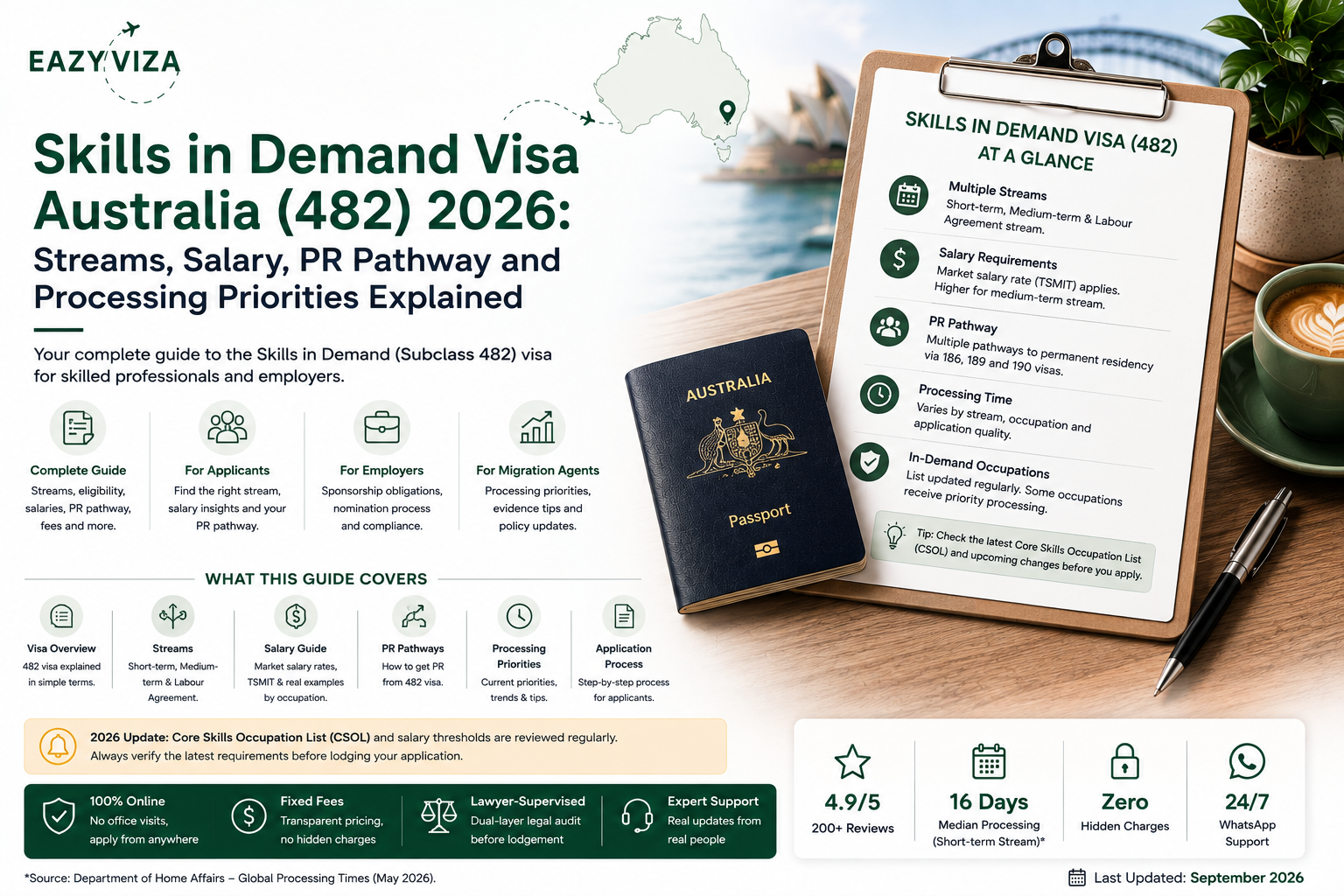
Quick answer: There is no publicly available list of approved 482 sponsors in Australia. To find companies that sponsor, search SEEK and LinkedIn Jobs using terms like "482", "sponsorship" or "skills in demand" alongside your occupation title. Focus on sectors that received Tier 2 priority processing under Ministerial Direction 119 from 25 July 2026, specifically healthcare, construction, and teaching. Companies in these sectors have faster sponsored applications, which gives them a real reason to go through the process. Before approaching any employer, confirm your occupation is on the Core Skills Occupation List (CSOL), know your ANZSCO code, and get your skills assessment moving. Source: Home Affairs, Skills in Demand visa (Subclass 482).
Why There Is No Approved Sponsor List in Australia
New Zealand's Immigration Department publishes a searchable register of accredited employers. The United Kingdom maintains a list of licensed sponsors that anyone can access online. Australia has neither. The Department of Home Affairs treats Standard Business Sponsor status as a private business record. It is not publicly disclosed, and that position has not changed despite repeated requests.
FOI requests to Home Affairs filed by various individuals over the past several years have all come back with the same answer: the department acknowledges that approved sponsors exist but will not release identifying information about them. One request even asked for a partial list sorted by state. That was refused too.
So the starting point for anyone looking to find a 482 sponsor is not a database you can search. It is a process of identifying companies where sponsorship is likely, based on signals you can actually find. Past job listings, LinkedIn team profiles, ABN registration history, and sector activity all give you useful indicators. None of them hand you a verified list. What they do is give you a shortlist worth pursuing, and that is the practical starting point this guide builds toward.
What You Are Asking the Employer to Do
Need expert guidance?
Speak with a migration specialist
Get personalised advice on your visa pathway — response within 2 hours.
Before walking into any conversation about sponsorship, it pays to understand what you are actually asking the company to take on. The Skills in Demand visa (Subclass 482) is a three-stage process. The employer carries the first two stages. The applicant handles the third.
The most practically useful question to ask about any potential employer is not whether they will sponsor you. It is whether they already hold SBS status or are willing to apply for it. A company that has sponsored before understands the costs, has a migration process in place, and knows roughly how long things take. A company that has never sponsored is being asked to build that understanding from scratch before anything else can happen. The difference in how those two conversations go is significant.
What the Employer Actually Pays
Many companies say no to sponsorship without ever looking into what it costs. If you know the numbers before the conversation, you can address that uncertainty rather than let it kill the discussion before it starts.
| Employer cost | Amount (2026) | Who pays | When |
|---|---|---|---|
| Standard Business Sponsor (SBS) application, only if not already approved | AUD 420 (one-time, valid 5 years) | Employer only. Cannot be passed to the worker. | Before nomination |
| Nomination fee | AUD 330 per nomination | Employer only | At Stage 2 lodgement |
| SAF levy for businesses with annual turnover under AUD 10 million | AUD 1,200 per visa year | Employer only. Cannot be passed to the worker. | At Stage 2, paid upfront for full visa duration |
| SAF levy for businesses with annual turnover AUD 10 million or above | AUD 1,800 per visa year | Employer only | At Stage 2 lodgement |
| Labour Market Testing advertising | Typically AUD 200 to AUD 800 depending on platforms | Employer only | Before nomination is lodged |
| Migration agent fees for SBS and nomination, if the employer uses one | Typically AUD 2,000 to AUD 5,000 for both stages | Employer decision | Varies |
Under Australian migration law, an employer cannot pass any of these costs to the visa applicant. The SBS fee, nomination fee, and SAF levy are all the employer's legal obligation. That means no reimbursement arrangements, no salary deductions, and no side agreements asking the worker to cover any part of these costs. Asking an applicant to contribute is a breach of sponsorship obligations and can cost the employer their SBS status.
If a company agrees to sponsor but tells you the costs need to come from your side in some form, treat that as a serious red flag before going any further. Source: Home Affairs, Standard Business Sponsor obligations.
Finding Companies That Already Sponsor on Job Boards
Job boards are the most efficient starting point because the evidence is already there. A company that has listed a 482-ready role in the past is either already an approved SBS or has gone through the process at least once. Either way, the friction of a first-time conversation about sponsorship is much lower.
SEEK search operators
SEEK's keyword field takes plain language. Use these combinations inside your occupation category:
- "sponsor" or "sponsorship" alongside your job title, to filter for listings where companies have proactively mentioned visa sponsorship in the ad copy
- "482" or "skills in demand" alongside your occupation title, to show listings that name the visa type specifically. Companies that include this usually have a working knowledge of the process.
- "temporary work visa" or "employer sponsored" as a broader sweep that catches listings using different phrasing
- Set location to All Australia rather than a single city. Companies that sponsor are often willing to discuss relocation, particularly for hard-to-fill specialist roles.
Set email alerts on these searches. Companies that post 482-friendly listings tend to do it more than once. An alert means you see the listing when it goes up rather than days later when it is already crowded with applicants.
LinkedIn Jobs
There is no explicit sponsorship filter on LinkedIn Jobs in Australia, but you can build one manually:
- Search your job title in Australia, filter by Full-time and On-site, then search within results for the word "sponsorship" or "482"
- For any listing that looks interesting, go to the company page and click People. If a meaningful share of the team shows international backgrounds or career histories, the company is already comfortable hiring from overseas and more likely to be SBS-approved
- Look for whether the company has a Global Mobility or International HR function in their team listing. Businesses large enough to have dedicated mobility staff are operationally ready for sponsorship in a way that smaller companies without that infrastructure are not
Industry-specific boards
Sector-specific boards tend to draw employers who are already active in that occupation's hiring market, and sponsorship rates tend to be higher than on generalist boards:
- Healthcare: HealthcareLinkRecruit.com.au, AlliedHealth.com.au, NursingJobSearch.com.au
- Engineering: CivilEngineerJobs.com.au, EngineeringJobs.com.au, Engineers Australia job board
- IT: ACS.org.au job board, ITJobs.com.au, SEEK IT category
- Education: ChildcareJobs.com.au, TeachingJobs.com.au, AITSL job board
- Construction: BuildingJobSite.com.au, SEEK Construction and Architecture
Which Sectors Are Most Likely to Sponsor in 2026
Not every sector approaches sponsorship the same way. The ones most likely to do it are those facing genuine skill shortages that local hiring cannot solve, and from 25 July 2026 some sectors have an additional processing incentive under Ministerial Direction 119 that makes sponsorship more practical for them.
When you approach a company in healthcare, construction, or teaching, one of the most useful things you can tell them is that their 482 application will be processed faster than applications from other sectors. Tier 2 priority processing under Ministerial Direction 119 is a real operational advantage, and most employers in these sectors do not know about it yet. Mentioning it positions you as someone who has done their homework and makes the sponsorship decision feel less like a leap into the unknown.
How to Verify a Company Before You Commit to Their Process
Ten minutes of basic research before a long interview process tells you a lot about whether sponsorship is genuinely on the table or whether it will hit a wall three months in.
Search the business name and confirm the ABN status shows as Active, GST registration is current, and the entity type is a proper corporate structure such as Pty Ltd rather than a sole trader. Home Affairs requires sponsors to be lawfully operating businesses. A company registered in the last few months or operating as a sole trader will face complications at the SBS stage.
Confirm company status shows as Registered, not Deregistered or Under Administration. A company under external administration cannot hold or apply for SBS status. This check takes about two minutes and can save you weeks of wasted effort.
Go to the company's LinkedIn page, click People, and look at where team members are based or where their careers have taken them. If you can see staff with non-Australian backgrounds who have been with the company for two or more years, the company almost certainly already holds SBS approval. People do not stay in 482-sponsored roles at companies that cannot actually sponsor.
Search the company name on SEEK alongside the word "sponsor" or "482". Past listings that mention sponsorship are one of the strongest available signals. A company that has run 482-ready job ads before has been through the process at least once. That is a very different starting point from a company that has never thought about it.
Search the company on LinkedIn and go to their Posts tab. Some companies actively share content about their international hiring programs or diversity initiatives that include visa support. Seeing that kind of post before an interview gives you a legitimate hook for the sponsorship conversation rather than raising it cold.
Reaching Companies That Are Not Actively Advertising
Some of the companies most willing to sponsor are not running job listings at the moment you are looking. They will hire when the right person appears. Direct outreach on LinkedIn is how you get in front of those companies before anyone else does.
The goal of the first message is not to ask about visa sponsorship. It is to start a conversation about the role itself. Sponsorship becomes a natural topic once there is real mutual interest, not before.
Who to contact
Aim for Hiring Managers or Technical Leads in your area of work rather than going to recruiters first. The person who actually manages the skills gap you could fill is the one with the most motivation to advocate for sponsorship internally. A recruiter working across many roles has less personal investment in any single hire. Reach the person who feels the gap daily.
What the first message should do
Reference something specific about the company or their work. A recent project announcement, a challenge their sector is publicly navigating, or a piece of their published work that connects directly to your experience. Generic messages asking whether positions are available get ignored. A message that shows you have actually looked at what the company does gets read.
Hi [Name], I noticed [Company] has been expanding its [specific team or area]. I have [X years] in [specific occupation] with experience in [specific relevant thing] and I am currently in Australia on [visa type], exploring senior opportunities in this space. I would value the chance to connect if there is ever a fit worth discussing.
When and how to raise sponsorship in the interview
Raising sponsorship in the first interview almost always works against you. It shifts the conversation from the role itself to an administrative question the employer is not ready to answer yet. The right moment is when they start discussing next steps, offer timelines, or onboarding plans. At that point, both sides have already decided there is genuine fit, and the sponsorship question is about solving a practical problem rather than asking for a favour.
Before the interview, confirm your occupation is on the Core Skills Occupation List and have your ANZSCO code ready. Knowing the specific code, not just your job title, signals that you have already done the preparation.
"I want to flag that I would need visa sponsorship to continue working here beyond my current arrangements. Specifically, the Skills in Demand visa (Subclass 482). For a role like this, the employer's part of the process involves SBS approval and a nomination, with government fees the employer covers directly. I am happy to walk through exactly what that involves if it would help."
This framing discloses the requirement honestly, shows you understand how the process works, and positions the next step as something you can help make easier rather than something you are asking them to figure out alone.
What to Have Ready Before You Approach Anyone
A candidate who walks into the sponsorship conversation knowing their own eligibility position reduces the employer's biggest concern, which is that this will be complicated. Most employer hesitation about sponsorship comes from not understanding the process, not from genuine unwillingness to sponsor the right person. Your preparation removes the uncertainty on their side before they have to voice it.
The 482 visa is assessed against the ANZSCO description for the nominated occupation, not against your resume job title. Those two things do not always align. Look up your occupation on the Home Affairs skilled occupation list and find the ANZSCO code that best describes what you actually do day to day. Having this ready makes you look informed and saves the employer one step of research.
Not all occupations qualify for the Core Skills stream. Check the live Core Skills Occupation List before approaching employers. If your role is not on it, you need your offered salary to clear the Specialist Skills Income Threshold (AUD 146,717 from 1 July 2026) to qualify under the Specialist Skills stream instead.
Skills assessments take 8 to 16 weeks for most applicants. An employer who is genuinely interested in sponsoring you does not want to wait four months before the visa process can begin. Having an assessment underway or already completed signals that you are serious and reduces the employer's perceived risk significantly. Our skills assessment service covers the right assessing authority for your specific occupation.
The minimum English requirement for the 482 visa is IELTS 5.0 overall with no individual band below 4.5, or an equivalent score in PTE Academic, TOEFL iBT, OET, or another accepted test. Most tests are valid for 3 years. If yours has expired or you have not sat one yet, schedule it now. Passport holders from the UK, USA, Canada, New Zealand, and Ireland are generally exempt from the English test requirement.
Can you work for any employer right now? Are there restrictions on your hours? Are you in Australia or offshore? These are the first practical questions HR will ask once sponsorship is on the table. Having clear answers ready removes ambiguity and helps the employer understand your current situation without having to look it up themselves.
Sector by Sector: Where to Direct Your Search
| Sector | High-demand 482 roles | Direction 119 tier | Salary vs CSIT (AUD 79,499) | Where to search |
|---|---|---|---|---|
| Healthcare | Registered nurses, aged care workers, midwives, physiotherapists, radiographers | Tier 2 Priority | Nurses: AUD 75,000 to 95,000. Senior clinical roles: above CSIT. | Healthcare Link, hospital system careers pages (Alfred, Monash, St Vincent's, Calvary) |
| Construction | Civil engineers, project managers, site supervisors, quantity surveyors | Tier 2 Priority | Most roles AUD 90,000 to 130,000 and above CSIT | SEEK Construction, tier 1 contractors (Multiplex, John Holland, Lendlease, CPB Contractors) |
| Education | Secondary teachers in maths, science, and STEM, early childhood educators | Tier 2 Priority | Teachers: AUD 75,000 to 95,000. ECEC roles: at or near CSIT. | Catholic Education employment portals, state education department career sites, ChildcareJobs.com.au |
| Information Technology | Software engineers, ICT project managers, business analysts, database admins, cybersecurity analysts | Tier 3 Standard | Most IT roles AUD 90,000 to 150,000 and above CSIT | SEEK IT, LinkedIn Jobs, ACS.org.au, direct approach to large tech employers and consulting firms |
| Accounting | Accountants, external auditors, financial analysts, tax advisors | Tier 3 Standard | AUD 80,000 to 110,000, at or above CSIT | SEEK Accounting, Big 4 and mid-tier firm careers pages, CPA Australia job board |
| Hospitality | Chef de partie and above, pastry chefs, head chefs (CSOL-listed roles only) | Tier 3 Standard | Often at or near CSIT. Salary compliance matters here. | SEEK Hospitality, Hospoworld, direct approach to restaurant groups and hotel chains |
Our lawyer-supervised team prepares both the applicant visa file and the employer's nomination covering salary compliance against the CSIT of AUD 79,499 from July 2026, Labour Market Testing review, stream confirmation, and full document preparation. Fixed pricing, file start within 24 to 48 hours. Use our free eligibility checker to confirm your stream before your employer lodges anything, or chat with our team on WhatsApp for same-day guidance on where you stand.
Skills in Demand (482) Cluster: Related Guides
Streams, salary thresholds, fees, processing times, PR pathway, and family members.
Lawyer-supervised applications for both applicants and employers. Fixed pricing.
We prepare and lodge the SBS application and nomination for Australian employers.
Skills assessment preparation for the right assessing authority for your occupation.
Last reviewed: September 2026. Three-stage process confirmed against Home Affairs, Skills in Demand visa (Subclass 482). SAF levy amounts confirmed against Home Affairs sponsor obligations page. CSIT (AUD 79,499) and SSIT (AUD 146,717) confirmed from 1 July 2026. Ministerial Direction 119 processing priorities confirmed effective 25 July 2026. Always verify current fees and occupation list at immi.homeaffairs.gov.au before lodging.
Frequently asked questions
Where can I find the employer sponsor list in Australia?
There is no publicly available list of approved Standard Business Sponsors in Australia. The Department of Home Affairs does not publish one, and Freedom of Information requests have confirmed this. Unlike New Zealand, which publishes a searchable register of accredited employers, Australia treats sponsor status as a private business record. The practical alternative is to identify companies that are likely to be approved sponsors through SEEK job listings that mention "482" or "sponsorship," LinkedIn team composition, and ABN Lookup verification.
How do I check if a company is an approved 482 sponsor?
You cannot check directly since no public register exists. Indirect signals that a company is likely SBS-approved: they have previously listed jobs on SEEK mentioning "482" or "visa sponsorship," their LinkedIn team includes international hires who have been with the company for more than two years, and the company has been operating for more than 12 months with an active ABN on abr.gov.au. You can also ask directly in an interview — most companies that are already sponsors will confirm it.
Can I approach a company directly about sponsoring my 482 visa?
Yes, and direct outreach through LinkedIn is often more effective than applying to advertised roles. Target Hiring Managers or Technical Leads in your occupation rather than generalist recruiters. The first message should reference something specific about the company's work rather than asking about sponsorship. Once there is mutual interest in a role, raise sponsorship as a practical detail — not the opening of the conversation. If you are already in Australia, mention it: onshore applicants are processed before offshore applicants under Ministerial Direction 119, which is a genuine advantage for the employer.
Which industries are most likely to sponsor 482 visas in Australia in 2026?
Healthcare, construction, and education are the highest-likelihood sectors, partly because they face genuine skill shortages and partly because their 482 applications receive priority processing under Ministerial Direction 119 (effective 25 July 2026). This gives employers in these sectors a practical incentive to sponsor — their applications move faster. IT is the next highest likelihood given structural skill demand, though IT applicants applying offshore face Tier 3 standard processing rather than Tier 2 priority.
How long does it take from finding a sponsor to receiving the 482 visa?
The full timeline depends on whether the employer is already an approved Standard Business Sponsor. If they are: Stage 2 nomination processing takes 2 to 8 weeks, and then the visa application takes 2 weeks to 6 months depending on occupation tier and whether the applicant is onshore or offshore. If the employer needs to become a sponsor first (Stage 1), add 4 to 5 months. Healthcare, construction, and teaching applications processed under Direction 119 Tier 2 priority move faster throughout the chain.
How much does it cost the employer to sponsor a 482 visa?
The minimum employer costs are: AUD 420 for Standard Business Sponsor approval (one-time, valid 5 years, only if not already approved), AUD 330 nomination fee per role, and the SAF levy — AUD 1,200 per visa year for businesses with annual turnover under AUD 10 million, or AUD 1,800 per visa year for larger businesses. Labour Market Testing advertising adds approximately AUD 200 to AUD 800. Under Australian law, none of these costs can be passed to the visa applicant.
Is it hard to find a 482 sponsor employer in Australia?
It depends on your occupation and sector. Healthcare workers, engineers, and IT professionals in occupations on the Core Skills Occupation List with salaries meeting the CSIT (AUD 79,499 from 1 July 2026) find sponsoring employers more readily because genuine skill shortages make the employer motivated to go through the process. The difficulty is not the sponsorship process itself — it is finding the right conversation with the right employer. Most skilled professionals who secure sponsorship do so through direct LinkedIn outreach or referrals, not through advertised roles.
What should I prepare before approaching employers about 482 sponsorship?
Know your ANZSCO occupation code — not just your job title. Confirm your occupation is on the Core Skills Occupation List (CSOL) or that your expected salary clears the Specialist Skills Income Threshold (SSIT: AUD 146,717). Have your skills assessment underway or completed — they take 8 to 16 weeks and a waiting employer loses confidence quickly. Have a current English test result if applicable. Know your current visa work rights clearly. A candidate who understands their own eligibility position makes the employer's decision significantly easier.